









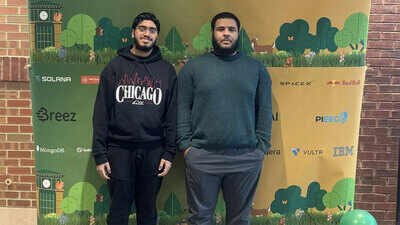
Two students from Benedictine University in the US, Ismail Abu-Shanab and Hamza Ahmad, have won first place in the Best Use of SSOJet category at Hack the Nest, a hackathon hosted by Eastern Michigan University. The competition attracted around 200 participants, with the two students securing the award for developing Interviewlenz, an application that uses artificial intelligence to help users prepare for coding interviews.The achievement came at the students’ first hackathon. Both are S-STEM scholars at Benedictine University and developed the application after identifying a gap in how students prepare for technical interviews. Their project combines coding practice with AI-powered feedback, allowing users to explain their code and receive responses from an AI interviewer.
How students developed the AI-powered Interviewlenz app
The idea originated from Ismail Abu-Shanab’s experience as a learning assistant for the university’s CMSC 3270 Data Structures II course, taught by Husam Ghazaleh, assistant professor of computer science.When a student approached him for advice on preparing for coding interviews, Abu-Shanab realised that existing preparation methods did not fully address the need for interactive practice and feedback.This prompted the duo to develop Interviewlenz, an application that allows users to practise coding while an AI interviewer evaluates their work and offers feedback.“So we built Interviewlenz, an app where you practice coding while an AI interviewer talks with you about your code and gives you feedback,” Abu-Shanab said, as quoted in Benedictine University’s official announcement.The team initially considered around 10 ideas before settling on the final concept. The students then spent the night developing the application, fixing technical issues and redesigning the website before submitting their project close to the deadline.
Students win $1,000 in SSOJet credits
The project earned Abu-Shanab and Ahmad first place in the Best Use of SSOJet category. The award included $1,000 in SSOJet credits.Recalling the moment their names were announced, Abu-Shanab said the students were surprised by the result.“When they called our name, we were both in shock,” he said, adding that he was particularly proud of how much the two had accomplished together despite the challenges during development.
NSF-funded programme supports STEM students
Both winners are part of BenSTEMS: Empowering Futures in STEM through Academic, Social, and Financial Supports, an initiative supported by a $1.58 million grant from the US National Science Foundation’s Scholarships in Science, Technology, Engineering, and Mathematics (S-STEM) programme.The initiative supports Benedictine University undergraduates pursuing degrees in subjects including biochemistry and molecular biology, chemistry, physics, engineering, mathematics and computer science.Abu-Shanab also credited his summer research experience and participation in the university’s learning assistant programme for helping him develop the skills needed for the competition.The win marks an encouraging start to the students’ hackathon journey, while Interviewlenz demonstrates how classroom experiences can inspire technology solutions aimed at addressing practical challenges in education and career preparation.
About The Author