










In 2025, scientists reported that a deep-sea mining experiment conducted in the Pacific Ocean more than four decades earlier had left lasting changes to the seabed and the animals living there. The research, published in Nature and reported by the Natural History Museum, examined a site where mining equipment had removed mineral-rich rocks in 1979. Although some small animals had returned, larger creatures that depend on these rocks remained scarce. The findings offer rare evidence of how slowly deep-sea ecosystems can recover after industrial disturbance.
What the scientists found at Pacific seabed mining site
The study examined an area in the Clarion-Clipperton Zone, a vast stretch of the Pacific Ocean between Mexico and Hawaii. The region has attracted interest from mining companies because its seabed contains polymetallic nodules, potato-sized mineral deposits rich in metals such as nickel and cobalt.According to the Natural History Museum, an international research team led by Professor Daniel Jones of the National Oceanography Centre, alongside Natural History Museum scientists including Dr Adrian Glover, revisited the site to investigate the long-term consequences of mining.The original industrial mining trials took place in 1979. In 2023, researchers returned aboard the Royal Research Ship James Cook, using the underwater robotic submersible Isis to examine the old tracks and document the surrounding marine life.The results, published in Nature, provided evidence that the effects of mining could persist for decades, even in an environment far removed from everyday human activity. The researchers also found signs that some parts of the ecosystem were beginning to recover, revealing a more complicated picture than permanent damage alone.
The mining tracks remain visible after four decades
One of the clearest findings was the survival of the physical marks left by the mining equipment. The Natural History Museum explained that the tracks remained remarkably distinct, with an approximately 8-metre-wide strip of seabed cleared of nodules and two deep furrows created as the machine moved across the ocean floor.The 100-tonne machine had disturbed the sediment while collecting the mineral deposits. Yet the marks had changed surprisingly little over the following 44 years. Researchers found the tracks within about 7-8 hours of their first dive during the 2023 expedition.This persistence reflects the conditions of the deep sea. At depths of around 5,000 metres, animal populations are often sparse, and the movement of sediment is slow. Natural processes that might gradually soften or cover marks left by machinery take much longer than they would in more active environments.The furrows appeared to collect more organic material than the flatter seabed around them. This created local differences in the availability of food, attracting greater numbers of animals that feed on the accumulated material.
Some deep-sea animals have returned to the disturbed areas
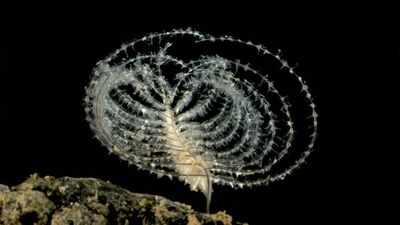
The biological findings offered a mixed picture. According to the study, some animals living on or within the sediment had recolonised the old mining tracks. Their numbers had returned to levels similar to those found in undisturbed areas.Small, mobile creatures appeared better able to return than larger animals that remain attached to the seabed. The researchers also found that xenophyophores, large single-celled organisms resembling amoebae, had recolonised parts of the disturbed area. These organisms are commonly found throughout the Clarion-Clipperton Zone.However, the return of some animals did not mean that the entire ecosystem had recovered. Larger creatures, including animals that rely on the mineral nodules for a place to live and grow, remained rare within the tracks.The absence of these rocks is particularly important because they provide a firm surface for organisms such as sponges and corals to attach themselves to. Many of these animals cannot simply move to another location in the way that mobile species can.
Sediment disturbance had a different effect on marine life
Mining can also disturb the surrounding seabed by sending clouds of sediment into the water. These plumes have been considered a potential threat because suspended material can settle over nearby habitats and affect organisms living there.However, the study found that sediment plumes had limited long-term physical effects at the investigated site. The researchers also detected no negative effect on animal numbers that could be attributed to the plumes.This result added an important distinction to the findings. The direct removal of mineral nodules and the physical tracks left by machinery had clear, lasting consequences, while the expected long-term effects of sediment plumes were not detected in the same way.That does not establish that sediment plumes are harmless in every deep-sea environment. Instead, the findings show that different aspects of mining disturbance can produce different outcomes.
The findings provide evidence for future mining decisions
Polymetallic nodules contain metals that are sought after for modern industrial uses, but the environmental consequences of extracting them remain a major concern.The Natural History Museum noted that limited knowledge of how deep-sea ecosystems recover has made it difficult to assess the long-term consequences of mining.Dr Adrian Glover explained that the results help researchers understand how different parts of an ecosystem respond at different rates. The study does not settle whether deep-sea mining should be permitted, but it provides evidence that can inform decisions about protected areas.
About The Author