











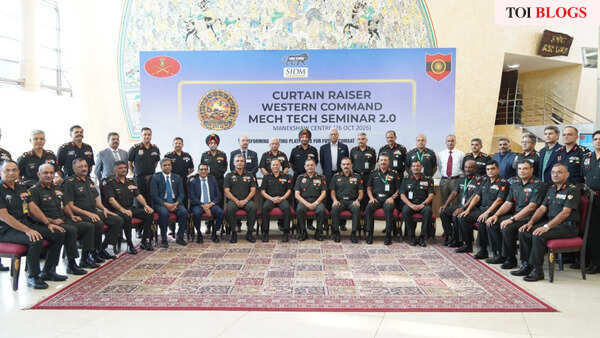
Military modernization is often measured by the number of new tanks, aircraft, warships or weapons a country acquires. But the changing character of warfare demands a wider understanding of military strength. The ability to upgrade existing equipment, integrate new technologies and respond quickly to emerging threats can be just as important as introducing an entirely new platform.As far as India is concerned, this is a particularly relevant question. The country must prepare its armed forces for an increasingly complex security environment while building a stronger domestic defence industry and reducing critical dependence on foreign suppliers. This calls for a modernization strategy that looks beyond fresh acquisitions and examines how existing military platforms can be made more capable, adaptable and effective.The Indian Army’s Western Command is taking up this challenge through the Mechanization Technology Seminar 2.0, or MTS 2.0, scheduled for December 14–15 at Chandi mandir Military Station. The seminar, themed ‘CHAKRA – Transforming Existing Platforms for Future Combat’, will bring together military personnel, defence manufacturers and academic institutions to explore technology-driven solutions for mechanized forces. Its curtain raiser was inaugurated by Lieutenant General. Pushpendra Singh, General Officer Commanding-in-Chief, Western Command, at the Manekshaw Centre in New Delhi on October 26.The significance of CHAKRA lies in the problem it seeks to address. Modern armies operate in an environment where technologies and tactics evolve rapidly. Equipment that meets operational requirements today may need new capabilities tomorrow. Sensors, communications systems, digital tools and other technological developments can change how military platforms perform, but integrating these advances into existing equipment requires careful planning, testing and technical expertise.Replacing every platform whenever a new requirement emerges is neither a simple nor an immediate solution. Upgrades, when technically feasible and operationally justified, can provide another route to improving capability. The challenge is to determine which systems can benefit from modernisation, what changes are required and whether those changes can deliver meaningful improvements under real operating conditions.This is where the Army’s engagement with Indian industry and academia becomes important. A military user understands the practical problems encountered in the field, but the solution may lie with a technology company, an engineering firm or a research institution that has not traditionally worked with the defence establishment. Equally, a company may have developed a technology without knowing whether it can address a specific military requirement.Bringing these groups together can help close that gap. CHAKRA places emphasis on translating operational capability gaps into clearly defined Problem Definition Statements. In simple terms, this means explaining the problem that needs to be solved before asking industry or researchers to develop the answer. A clear requirement gives innovators a better understanding of the Army’s needs and helps military users assess proposed solutions against practical objectives.The seminar’s focus on Combat Capability Enhancement, Harnessing Technology, Adaptability, Kinetics, Refurbishment and Atmanirbharta reflects the range of issues involved. The task is not simply to add technology to existing equipment. It is to identify improvements that make a platform more useful, reliable and suited to the conditions in which it must operate.That distinction matters. A technology that performs well in a laboratory may not necessarily withstand the demands of military service. Systems must be tested for reliability, compatibility, ease of maintenance and performance in challenging conditions. Upgrades must also work with existing equipment and operational procedures. Without these considerations, an attractive technological concept may struggle to become a practical military capability.India’s defence industry has an important role to play in this process. Start-ups and smaller technology firms can bring specialised expertise and new ideas, while established manufacturers can contribute engineering experience, production capacity and systems-integration skills. Academic institutions can support research, testing and the development of solutions to complex technical problems. The challenge is to turn these different strengths into a coordinated effort that responds to the Army’s actual requirements.This approach also has implications for Atmanirbharta, or defence self-reliance. Indigenous defence capability should not be judged only by how much equipment is manufactured within India. It must also include the ability to develop, maintain, repair and upgrade important systems at home. A country that can improve its existing military platforms using domestic expertise has greater flexibility in responding to changing requirements and less exposure to external supply disruptions.Closer cooperation between the Army and Indian industry can help build that capacity. Clearly articulated military requirements can guide research and investment towards areas of genuine operational need. At the same time, regular engagement with technology developers can help the Army identify solutions that may not emerge through conventional procurement processes alone.However, collaboration must lead to results. Seminars and industry interactions are valuable starting points, but their impact will ultimately depend on what follows: whether the problems identified are translated into workable solutions, whether those solutions undergo realistic evaluation and whether successful technologies can be adopted and supported over time. The process must provide room for experimentation without compromising military standards or operational reliability.The Western Command initiative therefore raises a larger question about how India approaches defence modernisation. The country needs new platforms and advanced systems, but it must also make considered use of the capabilities it already possesses. Modernisation should be driven by operational requirements rather than by the assumption that every problem requires an entirely new acquisition.The December seminar offers an opportunity to strengthen the relationship between military users, manufacturers and researchers. Its success should be judged not by the number of ideas discussed, but by whether it creates a clearer and more effective route from a field-level problem to a tested, practical solution.For India, the larger objective is to build armed forces that can adapt as quickly as the battlefield changes. That requires investment in new technology, a stronger indigenous industrial base and a procurement system that can turn useful ideas into dependable capabilities. Sometimes, the next step in military modernization will be a new platform. At other times, it may be a smarter way to upgrade the one already in service.Recognizing the difference, and acting on it effectively, will be central to building a more capable and self-reliant Indian Army.
Disclaimer: Views expressed above are the author’s own.
About The Author