










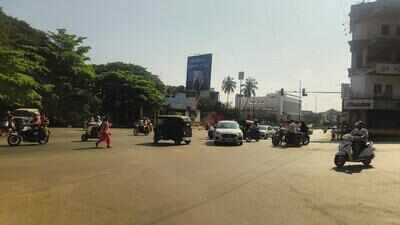
Dharwad: The Hubballi-Dharwad police commissionerate plans to install AI-based smart traffic signals at 14 locations for an estimated Rs 5 crore, and residents want the long-pending, unsafe crossings at Dharwad Court Circle and Toll Naka Circle included in the first phase.Residents expect the intelligent signals to improve traffic flow, cut unnecessary waiting and make crossings safer. Police commissioner Bhushan Borse has stressed the need for better traffic regulation to ease congestion and protect road users. Ensuring smooth traffic movement while prioritising pedestrian safety remains a major challenge for the Commissionerate.Crossing the Hubballi-Dharwad highway at these busy junctions has become a daily ordeal. There are no proper signals, vehicles approach from multiple directions, and BRTS buses move almost silently, making crossings particularly hazardous. Residents have demanded signals at these junctions ever since the Bus Rapid Transit System (BRTS) began running between the twin cities. The issue remains unresolved, leaving motorists and pedestrians struggling with chaotic traffic.Dharwad Court Circle has only a blinking yellow signal. Installing a proper one may require closing the crossing near Dharwad Hotel, opposite the court, a proposal that has faced objections. At Toll Naka, signal installation has reportedly been delayed over concerns involving a nearby temple. Residents believe stakeholder discussions can resolve both issues.Court Circle is particularly challenging. Vehicles travelling from the Old Bus Stand towards Malamaddi, the railway station, the Tahsildar’s office and the deputy commissioner’s office must negotiate traffic converging from six directions. Without regulated signals, confusion, speeding and violations are common.At Toll Naka, heavy traffic towards Kalaghatgi adds to the problem. Schoolchildren, college students, workers and office-goers struggle to cross during peak hours, and several pedestrians have reportedly been hit by vehicles. Poor visibility after 7pm makes crossing especially dangerous for senior citizens and women.11 accident-prone spots identifiedA report by Switzerland-based HESS LighTram, prepared under an agreement with the state govt, has identified 11 accident-prone locations along the BRTS corridor. It also flagged inadequate parking and poorly designed signals. Around 90,000 people use BRTS buses daily, while nearly 1.4 lakh travel by private vehicles. Poor signal coordination makes motorists wait unnecessarily, worsening congestion and frustration.Rash and negligent driving by some BRTS Chigari bus drivers, coupled with inadequate action by authorities to curb violations, has further aggravated the situation.
About The Author