









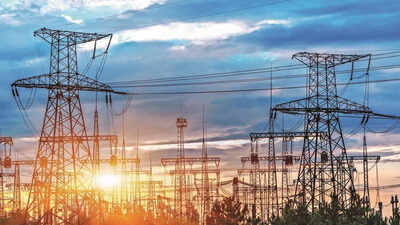
GURGAON: A city that contributes nearly half of a power utility’s earnings is now at the centre of a battle over who gets to supply its electricity.For private distributor Eleven Power, Gurgaon offers a lucrative market of industries, offices, commercial establishments and high-rise societies, where billing is strong and distribution losses are low. For state-owned Dakshin Haryana Bijli Vitran Nigam (DHBVN), those very consumers are its financial backbone. Losing them could weaken its ability to support areas where electricity supply costs more to maintain than the revenue it generates.At stake, therefore, is not just who supplies electricity to Gurgaon, but who gets access to its most profitable consumers. The numbers explain the attraction. In 2025-26, Gurgaon generated Rs 9,279.6 crore, or 42% of DHBVN’s total revenue of Rs 22,082.6 crore, despite accounting for only 33% of its billed electricity consumption. Farmland-heavy districts, where a substantial part of the supply goes to subsidised agricultural consumers, generate considerably less revenue relative to consumption.
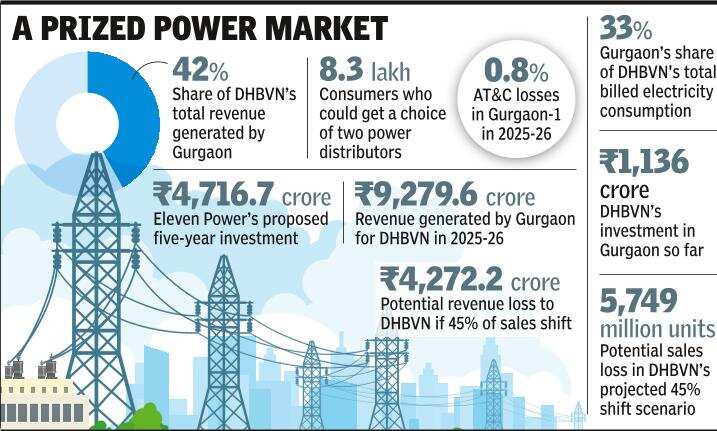
A prized power market
Among individual circles, Gurgaon-2 alone generated Rs 5,043.9 crore and Gurgaon-1 another Rs 4,235.8 crore. “Gurgaon accounts for a much higher share of the discom’s earnings than of its electricity consumption, reflecting the value of its urban, commercial and industrial consumer mix,” a DHBVN official said.The city is also an efficient market to serve. DHBVN’s average aggregate technical and commercial (AT&C) losses – electricity lost through distribution inefficiencies, theft and billing or collection gaps – stood at 8.4% in 2025-26. Gurgaon-1 reported just 0.8% and Gurgaon-2 1.6%. In comparison, Jind recorded losses of 36.7%. Lower losses mean more of the electricity supplied translates into billed and collected revenue.Eleven Power is betting on precisely this combination of concentrated demand, paying consumers and relatively efficient distribution. It sought a 25-year parallel distribution licence for Gurgaon and Nuh, covering Gurgaon city, Gurgaon suburban, Manesar, Sohna and Nuh. The proposal would give more than 8.3 lakh consumers the option of choosing between two distributors.The company proposed investing Rs 4,716.7 crore over five years, including Rs 4,650.4 crore in distribution infrastructure.For a private operator, winning even a small share of a market with high-paying consumers could make the investment worthwhile.For the state discom, the concern goes beyond losing electricity sales. Commercial and industrial consumers generally pay higher tariffs, helping support subsidised supply to households and farmers. This is known as cross-subsidy.The licensed territory of Gurgaon-1, Gurgaon-2 and Nuh generated Rs 9,493.8 crore in 2025-26 against sales of 12,776 million units. DHBVN estimated that if 45% of its sales in these areas shifted to Eleven Power, it could lose 5,749 million units of sales and Rs 4,272.2 crore in revenue at existing billing rates. This is a projected scenario, not an actual loss.There is another problem. The infrastructure cannot be dismantled simply because some consumers leave. DHBVN has already invested Rs 1,136 crore in the city and proposed another Rs 598 crore. It must continue paying for substations, lines, employees and power purchase commitments even if its consumer base shrinks.The city has hardly been free of supply problems. In May 2026, feeder and transformer faults caused outages lasting three to 12 hours in several areas, while residents complained of water shortages and repeated disruptions. During the Oct power employees’ strike against the private licence, some localities went without electricity for nearly 40 hours.
About The Author