








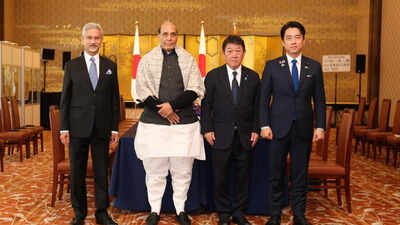
External affairs minister S Jaishankar and defence minister Rajnath Singh, during the fourth 2+2 foreign and defence ministerial meeting with Japan’s minister of defense Shinjiro Koizumi and minister for foreign affairs Toshimitsu Motegi in Tokyo on Thursday, shared commitment to a free, open, and rules-based Indo-Pacific and underlined the need for all countries to refrain from any attempt to unilaterally change the status quo.The two sides underscored the growing strategic convergence and trust between the two countries in an increasingly complex and uncertain international environment and stressed the importance of closer coordination under the India-Japan Special Strategic and Global Partnership in addressing present geopolitical, economic and security challenges. The ministers welcomed the growing defence and security partnership between both countries in line with the joint declaration on security cooperation, adopted at the last annual summit in Aug 2025.Jaishankar later flagged the growing “weaponisation” of connectivity, resources and supply chains, and called for stronger India-Japan cooperation amid global uncertainty, while Rajnath said the two countries agreed to accelerate cooperation in niche underwater and missile technologies and deepen maritime security ties.During his press statement after the 2+2 meet, Rajnath said, “During the course of our discussions today, we covered a wide spectrum of bilateral and regional issues of mutual interest. As two thriving democracies in Asia, we are pursuing a special strategic and global partnership. This year is significant for both India and Japan, as we lay the foundation for celebrating 75 years of establishment of our diplomatic relations in 2027. This is an important relationship for peace and prosperity in the Indo-Pacific region.”“We expressed satisfaction at the first-ever participation by Japan Air Self-Defence Force fighter aircraft during the Japan-India Air Force exercise “Veer Guardian 26”held in India. We welcomed the convening of the 3rd India-Japan Defence Industries Forum in Tokyo on 13th October 2026. Discussions on ongoing cooperation in the air and space domain awareness were also progressed,” he said.“We expressed our expectation for an early conclusion of the UNICORN related agreements and looked forward to further strengthening of defence industrial cooperation under the framework of ‘Design with Japan, Make in India’. We agreed to accelerate cooperation in the areas of niche, under water and missile technologies. We affirmed the need for early conclusion of a Maritime Ship Repair Arrangement (MSRA) for reciprocal provision of ship repair facilities and decided to enhance cooperation in mine-countermeasure capabilities,” the defence minister said.“Taking forward the recently signed memorandum of arrangement on maritime security cooperation, we concurred on moving swiftly to realise concrete cooperation, including in the fields of maritime and air domain awareness, Search and Rescue (SAR) and information sharing arrangements,” he said.The ministers unequivocally and strongly condemned terrorism and violent extremism in all its forms and manifestations, including cross-border terrorism, and called for concerted actions against all UN-listed terrorist groups and entities including Al Qaeda, ISIS/Daesh, Lashkar-e-Tayyiba (LeT), Jaish-e-Mohammad (JeM) and their proxies, and to take resolute actions to root out terrorists’ safe havens, eliminate terrorist financing channels and its nexus with transnational crime, and halt cross-border movement of terrorists.They reiterated their commitment to reform of the United Nations Security Council (UNSC), including expansion in both permanent and non-permanent categories, which a majority of Member States support, to better reflect the current geopolitical realities. The ministers reaffirmed their commitment to strengthening secure and resilient digital connectivity in the Indo-Pacific.Recognising the synergies between India-Japan bilateral cooperation and Quad’s four priority areas, namely maritime and transnational security, economic prosperity and security, maritime and transnational security, critical and emerging technologies, and humanitarian assistance and emergency response, the ministers underscored their commitment to leveraging bilateral cooperation to complement and reinforce Quad initiatives and deliver tangible benefits to partners across the Indo-Pacific.Taking note of the increasing incidence of cyber-attacks, the ministers concurred on the need to strengthen cybersecurity cooperation, including on AI-enabled cybersecurity and the security of AI systems, with particular attention to critical infrastructure. They directed their teams to renew the existing memorandum of cooperation in the field of cybersecurity and convene the next edition of the India-Japan Cyber Dialogue at an early date.They also concurred on expanding cooperation in the space field, including in space situational awareness (SSA), the use of space for maritime domain awareness, space-related international rules and norms, and other areas of mutual interest.
About The Author