









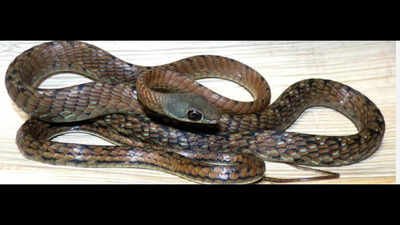
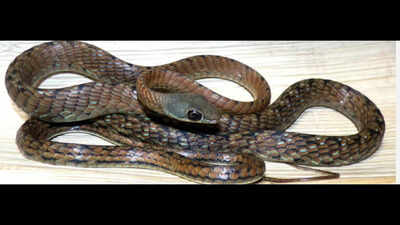
Imagine being lost for decades and then found in the depths of the Western Ghats! That’s what happened to the Beddome’s Bronzeback, the new tree snake species that’s recently been discovered.Tucked away in India’s Western Ghats, a mountain range famous for its sheer volume of unique plants and animals, there’s a new snake on the official records, and it somehow dodged the spotlight for ages. Researchers have just confirmed the existence of an entirely separate species of tree snake after years of confusing it with a lookalike cousin. According to Down to Earth, they’re calling it Beddome’s bronzeback (Dendrelaphis beddomei), and until recently, just about everyone lumped it in with the large-eyed bronzeback (Dendrelaphis grandoculis).What changed? Scientists pulled together decades-old records, museum specimens, photos, and sightings of live snakes and realized that this wasn’t just a matter of snakes with slightly different markings. They pieced together substantial differences, physically, in the places they live, and in how they behave.Now, this discovery isn’t just trivia for reptile fans. It’s a reminder that the Western Ghats, despite being one of the most heavily studied biodiversity hotspots in the world, still hide surprises. After the findings appeared in Taprobanica early this November, herpetologists also used the occasion to update the identity guide for southern India’s tree snakes, and to freshen up the description of the large-eyed bronzeback itself. In an almost poetic twist, the road, that ever-present hazard for India’s wild creatures, ended up helping scientists: two snakes found dead along highways provided the key evidence to prove that Beddome’s bronzeback was more than a “subtle variation.”
Beddome’s bronzeback: What makes the new tree snake its own species?
For starters, Dendrelaphis as a whole are slim, quick, and made for climbing — snakes that seem to flow through the treetops. Most people can’t tell one from another, but scientists, after a long look, started spotting the clues.The most obvious sign? Tongue color. Beddome’s bronzeback sports a red or pink tongue, not the black or dark-grey tongue of the large-eyed bronzeback. Look a little closer at the body, and you’ll notice a striking white stripe or a scatter of white spots running along the sides, which is a touch some individuals skip, but some go all in, even adding bold black blotches along their backs. None of these details show up on the large-eyed bronzeback.And that’s only the start. There are subtle differences in the scales too, especially the ones surrounding the eyes and running beneath the tail. In Beddome’s bronzeback, the loreal scale (that patch between the eye and the nostril) sticks out longer, and the second postocular scale is noticeably smaller. The tail? This new species packs as many as 168 pairs of scales under there, while its cousin falls short at 133 pairs or less. For scientists obsessed with systematics, these are the sorts of patterns that leave no room for doubt.
Where does this new bronzeback live?
So far, researchers say Beddome’s bronzeback lives only in the Western Ghats, specifically south of the Goa Gap, which basically works like a geographical hurdle that acts as a barrier for some wildlife. You’ll find it mostly at lower elevations: about 60% of all known sightings come from areas below 300 meters, but it can turn up anywhere from almost sea level to just over a thousand meters up.It’s not shy about its habitat, either. Unlike the large-eyed bronzeback, which tends to stick to lofty, evergreen forests, Beddome’s bronzeback seems happy in secondary forests, along rivers, and even in agricultural settings like areca nut or rubber plantations. Modeling their likely range, the team drew up a corridor between Puttur and Jog Falls in Karnataka, possibly stretching out toward Wayanad in Kerala and north into parts of Uttara Kannada. So, it’s got a decent patch of ground to work with, but it’s not found everywhere.
How the new species came to light
This breakthrough owes a lot to two snakes killed by traffic back in 2012 near Sullia in Karnataka. Finding roadkill might sound grim, but for biologists, it sometimes offers an opportunity that otherwise wouldn’t come along. These two tragic specimens, combined with old museum records and live sightings, including a bunch uploaded to the citizen-science site iNaturalist, helped researchers make their case.The new snake’s name is a tribute to Colonel Richard Henry Beddome, a 19th-century British naturalist who played a major role cataloging the wildlife, especially the reptiles and amphibians, of the Western Ghats. Fitting, considering he spent years in the same hills that this “new” bronzeback calls home.
The big picture about conservation
While the discovery itself is thrilling, there’s a sobering message here about the ongoing battle wildlife faces with roads crisscrossing the Western Ghats. Since both of the key specimens were roadkill, it’s clear that even species we hardly know can become victims of human expansion. Beddome’s bronzeback is active by day, spends most of its life above ground, and feeds mainly on tree frogs. It’s an egg-layer, and one female found dead on a road was carrying nine eggs, which speaks to the reality of its life cycle cut short.Given its limited range, the threats it faces from roads and habitat change, but also its presence in some protected areas, researchers think Beddome’s bronzeback deserves to be tagged as Near Threatened under the IUCN Red List, at least as a proposed status for now.
About The Author