









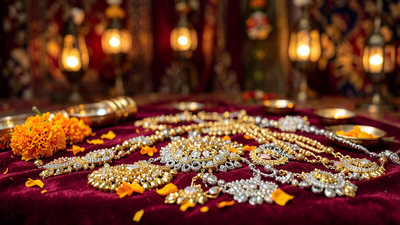
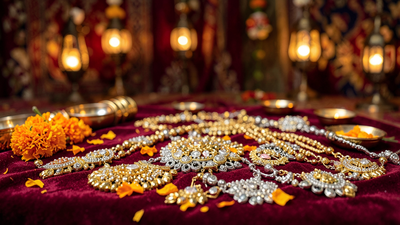
As the festive lights of Dhanteras and Diwali go up all over India, the old question comes back to us again: should you be buying gold or silver this year? But if you missed buying anything on Dhanteras, there’s still time to buy something precious.Gold is still the ultimate store of value and a true hedge against macroeconomic volatility and inflation. Silver is a very useful metal with a great deal of ceremonial value and a very strong industrial demand, plus it’s much more accessible. You don’t have to pick one or the other. A sensible approach is to have both: gold for your long term wealth, and silver for the more tangible stuff in your life (jewellery, cutlery, gifts etc).Getting through the festive market requires a certain financial discipline, an awareness of what’s ethically priced and an understanding of gemology that goes well beyond the typical retail marketing hype. Experts at C. Krishniah Chetty Group of Jewellers, share what to buy on Diwali.
Market volatility: Managing price swings through systematic planning
Precious metal prices are constantly in flux due to the state of the global economy. Trying to ‘time’ the market during the peak of the festive shopping period is a recipe for inaction and missed opportunities. The best approach is not to try and predict price movements but to use a structured method of buying.The Rate Protection Plan: Introduced in the early 1990s, this is a copyrighted plan which enables the customer to save via monthly installments over an 11 month period. On maturity the customer will receive the lower of the average market rate during the period and the rate in force on the billing date. This protects the customer from rate increases whilst also locking in the benefit of any downward movement in price.Money Penny: For total payment freedom. The client can save any time, any place, any number of times a day (daily, any number of times a day, weekly or monthly) from ₹100 onwards with no late fees or penalties. Over the 11 month tenure the average rate is automatically taken across Gold, Diamond, Silver and Platinum. At maturity the client is entitled to up to 12% p.a. value, dual benefit rate protection, birthday bonuses and tracking via the mobile app.Paper vs. Physical metals: Digital metals provide a contemporary, storage-free method of building metal wealth. The purity is guaranteed, the value is tracked in real time and the assets are fully liquid so you can convert them into physical coins or jewellery at any time. That said physical hallmarked metals are still the only option for use in rites and rituals, for the security of having something tangible and for the value of them as family heirlooms.
Ethical discounts: Working out the net price you actually pay
Festive campaigns are full of “20% OFF” and “Zero Making Charges” type of banners. Ethical retailing is about total price transparency rather than hiding the true cost behind a high base price.Consumer value is entirely a function of the net price you actually pay.
Deconstructing diamond quality: 5 secrets beyond the certificate
When two diamonds claim identical grades or even identical lab certificate grades (say: EF VVS), price variations stem from optical physics and cut geometry:Avoid “Spillover Weight”:Carat is a measure of weight not surface area. A poorly or fairly cut stone will have the weight of a larger stone in the deep bottom (pavilion). A 1.5ct stone which is poorly or fairly cut may in fact have the surface spread of a 1.75ct stone. The problem with that is that the stone will be lifeless and dull – that’s the whole point of buying a natural diamond. You want to look at “Excellent/Ideal” cut grades that are of a high sustainable and consistent standard and check the mm dimensions. A properly informed and experienced salesperson will be able to explain the finer points – you need to insist on this when you’re buying a fine diamond. Not all diamonds are the same.Shop under the glass thresholds: Prices go up dramatically at the round whole numbers (1.00ct, 1.50ct). A 0.90ct to 0.95ct stone will give you the same visual footprint as a 1.00ct stone once it’s set, so you can save 20-30% on price. As ever, get advice from a more experienced associate.Medium Blue Fluorescence: Whilst strong fluorescence leads to haziness, Medium Blue fluorescence in the warm stones (G-I colour) is a natural colour corrector in the sun and will make the stone look whiter at a lower price. Fluorescence in natural diamonds is priced lower.Inclusion location: inclusions directly beneath the central “table” facet will reflect like a hall of mirrors. Inclusions positioned close to the outer edge (“girdle”) can be effectively hidden beneath the prongs of the setting for a truly eye clean stone.Lighting deception: specialist boutique spotlights will make even a badly cut stone appear to sparkle. Always assess your loose diamonds in ambient daylight or near a window to see the real fire and brilliance.
Master gemology: Rare gemstones, organic pearls and precision fitting
True luxury in fine jewellery goes well beyond just gold and diamonds. Getting the very best stones, the very best pearls and getting the ergonomics right all require a higher level of connoisseurship.Panjshir Emeralds v Standard: These are considered the best of the three with the most vivid green saturation and excellent crystalline transparency and very few inclusions.Natural rubies versus glass-filled corundum: Natural unheated rubies have enduring geological value. Glass-filled rubies are low grade corundum with lead glass. They’re very fragile and will deteriorate under heat or cleaning chemicals. Not used in high grade jewellery (although they are an inexpensive option in the lower end of the market).Conch & Melo Melo Pearls: Extremely rare and impossible to culture. Conch pearls (from the Queen Conch mollusk) and Melo Melo pearls (from sea snails) are non-nacreous organic wonders with a superb flamboyant surface pattern.Styles & Precision Fitting: When fitting broad ring bands they displace soft tissue so you need a quarter to half (or even a size one) larger than you would with a thin band. Rigid bangles have to clear the knuckles whereas hinged openable bangles can be fitted to the wrist in a very tailored manner.
Smart shopping practices & bespoke customisation
When you’re buying fine jewellery don’t just go for it based on how it looks in the shop counter light. Look at the design inspiration in advance (Pinterest is a good place to start), be very clear with your partner about what you’re after, go through the jeweller’s vault stock and/or plan your bespoke order well in advance to allow sufficient time for the master craftsman to do his work.
About The Author