









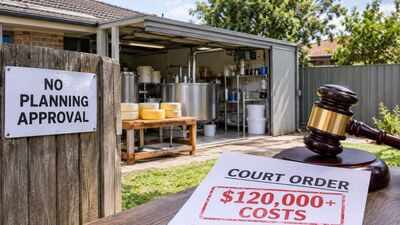
An Adelaide retiree has been ordered to pay more than A$120,000 in court costs after spending five years failing to remove an unauthorised cheese-making facility built in his suburban backyard. John Kitsis was found guilty of contempt of court after repeatedly ignoring orders requiring him to dismantle the operation at his West Croydon home. The dispute began when local authorities discovered the structures and dairy-making equipment without the necessary planning approval. Although the court gave him a deadline to comply, the facility remained in place for several years.
Why was the Adelaide backyard cheese-making facility ordered to be removed
As reported by ABC News, the dispute dates back to April 2018, when the City of Charles Sturt council received a complaint about unauthorised structures and dairy manufacturing equipment at Kitsis’s property in West Croydon, Adelaide.The complaint reportedly came from a person claiming to be a neighbour. It prompted council officers to investigate the property and establish whether the structures and proposed business had received the necessary approvals.During the investigation, Kitsis told council officers that he had permission to operate a cheese-making business but had not yet started the operation. Earlier court judgments also recorded that he had submitted a food business notification to the council, which acknowledged receiving the paperwork.However, submitting a food business notification did not mean that the construction itself had been approved. The council’s investigation found that the cheese-making facility had been built without the required planning permission.A further inspection in September 2018 revealed that a garage and rumpus room at the rear of the property had been converted into what council staff described as a self-contained residence. The converted space included built-in cooking appliances and laundry facilities.These findings eventually led to legal proceedings over the unauthorised development.
What did the court order Kitsis to do in 2020
In March 2020, the Environment, Resources and Development Court ordered Kitsis to remove the unauthorised cheese-making equipment from his property. The order covered the appliances and other facilities used for dairy production, including built-in cooking, storage and preserving equipment.The court gave him 30 days to comply with the directions. However, the order was not followed within the required period, and the matter continued for years.The court later examined the prolonged failure to carry out the removal. Senior Judge Michael Durrant found that Kitsis had deliberately disobeyed the directions.The delay became a central issue in the contempt proceedings. The original removal order had been issued in 2020, but the required work was not completed until June 2025.By then, Kitsis had already been found guilty of contempt of court in February 2025. His eventual compliance therefore came several months after the contempt finding. Judge Durrant considered the length of the delay particularly serious, noting that the original order had allowed only 30 days for compliance.

John Kitsis was ordered to pay more than $120,000 in court costs. Image Credit: ABC News/Che Chorley
How did Kitsis explain his failure to follow the orders
During the proceedings, Kitsis offered an explanation for why he had not complied with the court’s directions. According to ABC News, he arrived in Australia from Greece in 1990 and did not speak English. He suggested that this had made it difficult for him to understand what was happening during the legal proceedings.However, Judge Durrant did not accept that explanation as sufficient reason for the prolonged non-compliance.The judge was satisfied that Kitsis knew about the court orders and understood what he was expected to do. He also pointed out that Kitsis had family members who could communicate in English.Court records showed that Kitsis had communicated with both the City of Charles Sturt and the court, sometimes through his son and sometimes directly. This correspondence was considered evidence that he had been aware of the proceedings and the requirements placed on him.The case also involved earlier difficulties in getting Kitsis to attend court. He had been arrested after failing to appear and had spent 3 days in custody at the Port Adelaide police cells on one occasion.Judge Durrant described that step as regrettable but necessary, given the repeated failure to respond to the court process. The judge also gave little weight to Kitsis’s apology. It was made at the last minute and did not demonstrate a voluntary expression of regret or genuine remorse for ignoring the orders.
Why did the court impose more than A$120,000 in costs
In his ruling, published in December 2025, Judge Durrant described the contempt as being at the higher end of seriousness. He said Kitsis’s failure to comply had been wilful and criticised the fact that the removal order had remained unfulfilled for more than 5 years.The court also considered whether Kitsis had gained any financial advantage from continuing to operate the facility. During the proceedings, he told the judge that although he had operated a cheese-making business from the premises, it had never successfully got off the ground.According to his account, the business had generated no sales and had been unsuccessful. The court therefore considered his explanation when assessing the circumstances surrounding the contempt.Despite the seriousness of the conduct, Judge Durrant took Kitsis’s personal financial circumstances into account. The retiree was elderly, had limited income and was receiving a pension. For these reasons, the judge decided against imposing an additional penalty beyond the time Kitsis had already spent in custody.However, that did not remove his responsibility for the legal costs arising from the proceedings. The judge noted that Kitsis had already been ordered to pay substantial costs to the City of Charles Sturt council.He also directed him to pay further costs to the Registrar of the Environment, Resources and Development Court. The amount was set at A$123,266.36, taking the total financial consequences of the prolonged dispute beyond A$120,000.The case eventually reached a conclusion after Kitsis removed the unauthorised cheese-making equipment in June 2025. However, completing the removal did not erase the earlier failure to follow the court’s directions.
About The Author