










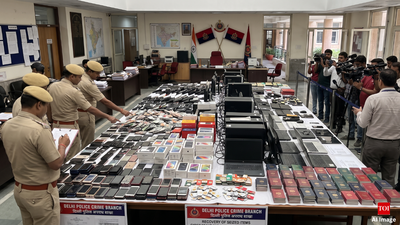
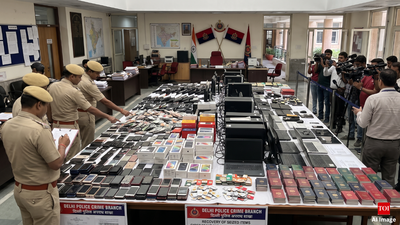
NEW DELHI: Promised well-paying jobs and better career opportunities in India, 164 nationals from Indonesia and Malaysia allegedly ended up trapped in a cyber slavery racket in Delhi, where their passports were confiscated, movements controlled and they were forced to cheat people in their home countries through fraudulent investment schemes.The Delhi Police Crime Branch rescued the foreign nationals during a crackdown in southwest Delhi’s Dwarka and arrested a 25-year-old Malaysian national in connection with the alleged international trafficking and cyber fraud network.The rescued group comprises 92 Indonesians and 72 Malaysians. The arrested accused has been identified as Tan Guan Wei.According to police, the syndicate specifically targeted people in Indonesia and Malaysia by offering them jobs in India with promises of attractive salaries and better career prospects. However, their ordeal allegedly started soon after they arrived in the country.Their passports were taken away, leaving them without access to their identity documents and limiting their ability to leave, police said. They were then moved into paying guest (PG) accommodations and allegedly made to work as cyber slaves.A senior police officer said those who resisted or refused to participate in the fraudulent activities were allegedly beaten by members of the network to force them into compliance. So far, investigators have learnt that around two people were thrashed, the officer added.The foreign nationals were allegedly housed in poor conditions and served substandard food. Although around 40 cabs were used to transport them between their PG accommodations and the cyber fraud call centre, they were not permitted to step out or move around independently, the officer said.“The cabs were allegedly deployed to transport them to the call centre and bring them back to their accommodations, ensuring that their movement remained under the control of the handlers,” the officer said.The victims were allegedly trained to carry out a particular method of cyber fraud rather than simply being asked to operate computers and mobile phones. They were given written scripts containing conversations that they had to follow while approaching potential targets.The syndicate primarily targeted people in Malaysia and Indonesia. Its members allegedly created fake female identities and social media profiles to approach unsuspecting individuals.“Using these profiles, the foreign nationals were instructed to initiate conversations, develop online relationships and gradually gain the confidence of their targets. Once trust was established, the victims were persuaded to invest money through fraudulent trading and investment platforms,” the officer added.The network allegedly operated through websites and APK-based applications that lured people with promises of high returns. Victims were led to believe that they were putting their money into genuine financial opportunities, while the funds were allegedly diverted through the fraudulent network.“We got to know about the fraud after the crime branch received an email alert about the alleged cyber slavery racket around a week ago, following which its officers began developing intelligence about the network,” the officer said.The initial intelligence suggested that around 60 to 70 foreign nationals were being confined and forced to work in the cyber fraud operation. However, when the police team raided the suspected premises, it found a much larger group. The operation eventually led to the rescue of 164 people, revealing the scale of the alleged racket.Investigators are now examining how the foreign nationals were recruited, who arranged their travel to India and how their passports were taken away.“During the entire investigation, two names – Sunil Kumar and Sushil Bhati – cropped up. Bhati used to arrange the PG accommodations and transportation facilities. Both are absconding, both will be arrested soon,” the officer said.Police have identified certain bank accounts allegedly operated by Kumar and Bhati, which were used to pay rents and meet other expenses related to the network. Investigators are tracing the financial transactions to establish the flow of money, identify the beneficiaries and track the proceeds of the alleged cyber fraud.Tan Guan Wei, the arrested Malaysian national and a resident of Negeri Sembilan, is being questioned about his alleged role in the operation, his links with other members of the syndicate and his involvement in running the fraudulent platforms.The Crime Branch has seized a large volume of digital equipment allegedly used to run the operation. The recoveries include 355 mobile phones, 168 desktop computers, 26 laptops, 53 SIM cards and 174 passports.Of the 355 mobile phones seized, 335 were old or used handsets, while 20 were new devices in sealed packaging. The SIM cards included 31 international and 22 Indian connections. The 174 recovered passports comprised 95 Indonesian and 79 Malaysian documents.Servers and other electronic equipment have also been seized. Investigators are analysing the devices to identify victims, trace the communication channels used by the syndicate and examine financial transactions connected to the fraudulent platforms.A case has been registered at the Crime Branch police station under relevant provisions of the Bharatiya Nyaya Sanhita. Further investigation is underway to identify other members of the alleged international network and determine the full extent of the human trafficking and cyber fraud operation.(With PTI inputs)
About The Author