









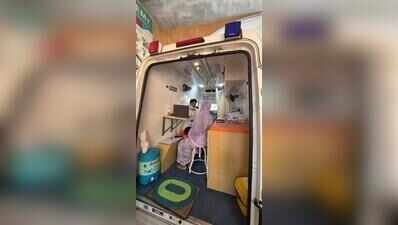
Pune: In the bylanes of Laxminagar in Yerawada, Asma Shaikh waits for her bi-monthly outpatient department (OPD) visit. This is no ordinary clinic; the doctor comes directly to her in a van modified into a mobile dispensary, where both diagnoses and medicines are provided completely free of cost.Mobile OPDs are quietly transforming the primary healthcare landscape in Pune’s slums. With govt hospitals perennially overburdened and daily-wage labourers often skipping treatment to avoid losing a day’s income, these portable clinics are delivering doctors, diagnostics, and medicines straight to the doorsteps of underserved neighbourhoods.When Asma Shaikh first noticed the van during her pregnancy in 2024, she assumed it was just another short-lived govt scheme. However, in urgent need of a check-up, she stepped inside the Smile Foundation van parked outside the Pune Municipal Corporation (PMC) community hall.“My first interaction with the doctor was very reassuring,” Shaikh recalled. “The doctor enquired about my health and gave me all the required supplements for free. The nurse also counselled me about maternal and infant vaccinations. The experience was so seamless that I still continue to come here whenever I have any health complaints.”The nearest public facility for Laxminagar residents is the PMC-run Rajiv Gandhi Maternity Hospital. For many, it requires a 30-minute commute, and the OPD operates only during fixed, restricted hours.Kausar Dalmia Shaikh, who works as a watchman, highlights the convenience: “The best thing about this mobile clinic is that it remains parked here for the entire day. I can visit the doctor after my shift, which isn’t possible at the hospital. I simply cannot afford to lose a day’s wages.” Dalmia visits the van twice a month to manage his diabetes and hypertension. “They give me a 15-day supply of medicines for free. Because the van returns to the exact same spot twice a month, managing my health has become incredibly easy.”Run by NGOs, these medical vans offer consultations, basic blood tests, eye screenings, and hospital referrals. By bringing healthcare closer to home, they significantly reduce travel times, wage losses, and out-of-pocket healthcare expenses for underprivileged families.The vans are also turning into powerful surveillance tools for public health. Unlike hospital registries, which only capture data from individuals proactive or sick enough to seek institutional care, door-to-door community screening uncovers true disease prevalence. This grassroots data can help authorities draft more effective, targeted public health policies.Satnam Singh, general manager of programmes (health initiatives and disaster response) at the foundation, was recently in Pune for a project inspection. “We have three vans operating in the city every day, screening an average of 90 patients daily. We estimate that about 4,500 patients are screened every month by our vans in Pune alone, and we have a wider network covering most districts across Maharashtra,” Singh said.“The core objective of the mobile OPD is to strengthen preventive health and raise awareness within the community,” Singh added. “While we do not conduct specialised testing, our doctors provide clinical diagnoses and refer patients to the nearest government or charitable hospitals when needed. We actively screen for vector-borne and water-borne infections, alongside providing crucial antenatal care (ANC). Our robust database allows us to provide real-time inputs to the government healthcare machinery so they can plan targeted interventions. As an immediate impact, we have significantly slashed out-of-pocket expenses for our patients, helped them manage chronic conditions effectively, and eased the structural burden on public hospitals.”From distributing free medicines to offering maternal care and vital hospital referrals, mobile OPDs are emerging as a robust parallel healthcare system—easing the pressure on public facilities while successfully expanding last-mile medical access.
About The Author