











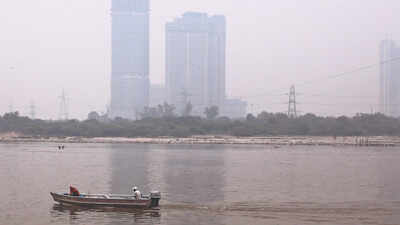
NEW DELHI: Delhi govt’s plan to build a 4.7-km reinforced concrete wall along Yamuna has raised concerns among experts, who warn that the intervention could restrict movement of floodwater, alter the river’s natural flow and potentially shift flood risks to other areas.Approved as part of a Rs 622-crore flood-control plan, the wall, estimated to cost Rs 99 crore, is likely to run from Magazine Road drain to Old Railway Bridge. The six-to-seven-foot-high structure is intended to protect vulnerable low-lying areas from inundation.But experts argue the project risks treating the symptoms rather than addressing why Yamuna has been reaching high levels even at comparatively lower upstream discharges.In Sept 2025, the river reached nearly 207.5 metres at Delhi’s railway bridge, while discharge at Hathnikund Barrage was reported at around 3.2 lakh cusecs. During the July 2023 floods, it rose to a record 208.66 m at a reported discharge of around 3.5 lakh cusecs.Experts say these patterns warrant investigation into changes in the river’s carrying capacity, floodplain encroachment, riverbed conditions and the cumulative impact of infrastructure.A senior govt official, who requested anonymity, questioned the logic of adding another barrier to an already constrained river. “When a river channel is already encroached upon, with buildings occupying its floodplain, putting up walls further restricts floodwater and can cause water levels to rise. Unequal pressure could even cause a wall to fail, potentially leading to catastrophic consequences,” the official said, warning that the risks needed careful assessment before construction.Pointing out that while such experiments work in Europe where rivers have consistent natural or environmental flow round the year, environmentalist Diwan Singh said the intervention in a largely monsoon-fed and restricted river like Yamuna could undermine the natural functioning.“This will hinder the natural flow of the river and aggravate flooding. It will make it more like a canal, which is not suitable for a monsoonal river such as Yamuna. Its floodplains exist to accommodate unpredictable flows. Tampering with their shape and size will be bad for both the river and Delhi,” he said.The concerns are significant given the existing network of bridges, barrages, embankments and riverside roads. A Central Water Commission 2025 study on Delhi’s 2023 floods recommends suitable flood protection at vulnerable locations, including Nili Chhatri, but does not specifically recommend the proposed 4.7-km concrete-reinforced wall. Its modelling also found that replacing certain existing lateral embankments with structures raised on piers could reduce water levels at some locations.Similar concerns have been raised over Delhi’s proposed 22-km Yamuna riverfront project, where experts stress the need to prioritise river restoration and floodplain protection over interventions that could further constrain the river.Govt’s wider flood-control plan includes spending Rs 260 crore on proposed biomining projects to process silt removed from major drains. While improved drainage may help reduce waterlogging, experts say it cannot replace a comprehensive assessment of the river’s carrying capacity and floodplain connectivity.“Construction of the wall should be reconsidered until the ongoing topographic and bathymetric surveys are completed. The changing relationship between upstream discharge and water levels in Delhi warrants an independent investigation into the river’s carrying capacity and the cumulative impact of existing infrastructure,” said Bhim Singh Rawat, associate coordinator of South Asia Network on Dams, Rivers and People (SANDRP).
About The Author