










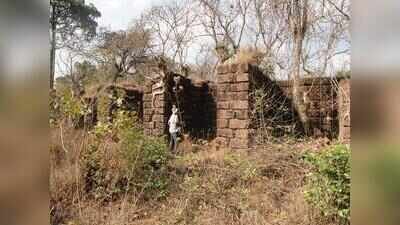
Panaji: Heritage lovers are awaiting the declaration of an 11-km outer fortification wall of Old Goa on the Azossim-Carambolim border as a monument of national importance. This Portuguese military engineering structure could conjoin with Rajbid, the Kadamba-era trade route, as the region’s unique layers of history.The 8-odd-km-long laterite stone-paved road, Rajbid or Rajvithi (royal road), of the 11th century, which stretched from Agasaim to Old Goa, was recently tagged by the chief minister to be protected as a state monument.Over a year earlier, Archaeological Survey of India (ASI), Goa circle, had submitted a proposal to its Delhi headquarters for protection of the 9-m-high laterite stone wall of the 16th and 17th centuries under sections 4(i) & 4(iii) of Ancient Monuments and Archaeological Sites and Remains Act (AMASR), 1958.ASI already has 21 monuments under its charge and has proposed inclusion of the 11-km remnant of the 20-odd-km wall once surrounding Old Goa, considering its importance and significance.The 2-km surviving stretch of Rajbid built in the 11th century by the Kadambas and the fortification wall, as historic remnants of different eras, lie about 1 km apart on Kadamba Plateau highly threatened by development.When the Portuguese conquered Old Goa city in 1510 CE, Adil Shah’s fortification wall was found to be inadequate. The city’s north-eastern passages of Daugim, Gandaulim and Banastarim needed to be secured from threats, and in 1566 CE, during Viceroy Antao de Noronha’s tenure, the construction began. The work was completed by 1581 CE and another stretch was extended from Banastarim to Azossim in the south. It is not known whether the Bainguinim stretch of the fortification wall in the north-west was fully extended.“The whole fortification wall – (forming a circle through seven villages) exhibits features like arched gateways, bastions, horse stable bays, etc.,” the ASI submission note states. “It is regarded as one of the better examples of Portuguese military engineering among its overseas colonies,” Abhijit Ambekar, then superintending archaeologist, Goa circle, said.Till a few years ago, only 11 km of it survived in a relatively good state of preservation.“The remnants of bastions traced at few locations are found to be 3–3.5m tall and also exhibit solid stone work devoid of any core filling,” as per the ASI submission during Ambekar’s tenure.Both sites, Rajbid built by King Jayskeshi I as the historical landmark of the glorious Kadamba era and the fortification wall, need to be notified as protected monuments,” Prajal Sakhardande, a history researcher, said.The 9-km trunk road connected two ancient and medieval port capitals. In addition, the plateau is an archaeologically diverse site with arches, moats, tanks and ponds which deserve protection as monuments, he adds.“The outer fortification wall and Rajbid have been largely lost due to neglect and development pressures but the remains have to be protected on priority due to their importance as heritage assets of our multi-layered past,” said Tomas Rodrigues, a history researcher.
About The Author