






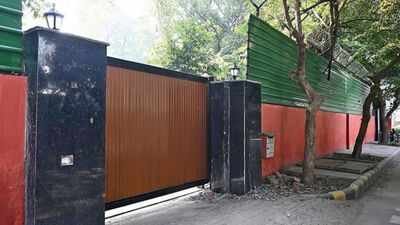
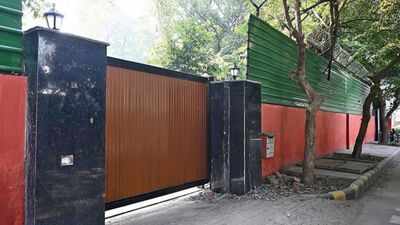
NEW DELHI: A crowd was waiting at the railway station when the Dalai Lama arrived in Delhi by train from Mussoorie on Sept 2, 1959, about five months after India granted him asylum. That evening, he met Prime Minister Jawaharlal Nehru for 90 minutes. Two days later, he asked the US ambassador in Delhi to help rally support for Tibet’s case at the United Nations, according to a US diplomatic cable.Nearly seven decades later, the Centre has allotted a govt bungalow at 20, Pandit Ravi Shankar Shukla Lane in Lutyens’ Delhi to the Dalai Lama’s office as a base for his visits to the capital. The office, Gaden Phodrang, was registered as a private trust in India after the Dalai Lama handed over political authority to an elected Tibetan leadership in 2011. Its work includes preserving Tibetan culture, fostering interfaith dialogue and supporting the study of ancient Indian thought.The Union housing ministry transferred No. 20 to ministry of external affairs at its request in Oct 2025, according to sources, who said such arrangements typically run for three years and can be extended. The term of this allotment has yet to be made public.No. 20 was previously listed as the Delhi residence of Union minister of state for finance Pankaj Chaudhary, who, according to reports, occupied it during his two Lok Sabha terms between 2014 and 2024 before moving to 35, Lodhi Estate, the address now listed on Digital Sansad.Months before the allotment, the bungalow was also up for renovation. A Central Public Works Department (CPWD) tender published on July 10 this year estimated security and related civil works at Rs 34.9 lakh and set July 17 as the deadline for bids.The bungalow’s paper trail runs through the street’s former name. A Dec 1999 Lok Sabha reply still called it ‘20, Canning Lane’ when it listed three rooms and a shed as unauthorised additions reported in July 1997.The lane had been renamed on Dec 31, 1991, in memory of Ravi Shankar Shukla, who died at No. 3 exactly 35 years earlier, according to a speech reproduced in the Journal of Parliamentary Information. A lawyer who joined Gandhi’s Non-Cooperation Movement and was arrested during the Quit India Movement, Shukla became the first chief minister of reorganised Madhya Pradesh on Nov 1, 1956, and died in office two months later.New Delhi Municipal Council’s conservation report places Canning Lane in a wider govt bungalow precinct north of Rajpath. It is classified as Type VII. CPWD design norms for new construction and reconstruction in the Lutyens’ Bungalow Zone provide for a 3,400 sq ft main residence, a 1,000 sq ft office, two garages, balconies and security facilities. The prescribed plinth area is 6,889 sq ft with four staff quarters and 7,319 sq ft with six. However, the actual dimensions of No. 20 remain unverified.The Dalai Lama’s ties with Delhi began before his exile. He came to the capital in Nov 1956 for Buddhist anniversary celebrations and met Nehru during the visit. After fleeing Tibet in 1959, he entered India through present-day Arunachal Pradesh and initially lived at Birla House in Mussoorie. His office’s travel log lists a Delhi visit that June. When the mayor hosted a civic reception on Sept 3, a day after his 90-minute meeting with Nehru, the Dalai Lama recalled the warmth of his 1956 welcome.Dharamshala became his home in 1960, and Delhi remained a regular stop. In 1965, he founded Tibet House, whose museum and library grew out of artefacts and books Tibetans carried into exile. His office documented a stay at a Tibetan Children’s Village student hostel in Delhi in 2013 and a meeting with former US president Barack Obama in the city in 2017. There were also reports that he stayed at a Delhi hotel in Oct 2023.The Dalai Lama’s office cited his age and the challenges of arranging stays and security for his Delhi visits as reasons for setting up a dedicated base in the capital.
About The Author