











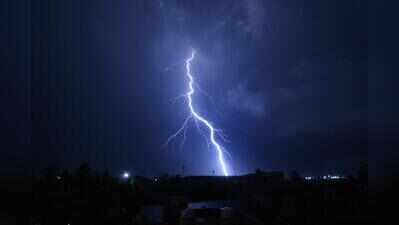
Bhubaneswar: Odisha has registered a decline in lightning-related deaths in recent years, with the state govt attributing the trend partly to early warning systems, even as the frequency and intensity of lightning incidents have increased due to climate change.Revenue and disaster management minister Suresh Pujari, in a written reply in the assembly on Thursday, said lightning deaths fell from 350 in 2019-20 to 243 in 2024-25, with a slight rise to 257 in 2025-26.Pujari said govt has reviewed the effectiveness of existing early warning systems in preventing deaths and damage to property caused by lightning. “Warning mechanisms have significantly helped reduce fatalities and losses. The govt is working to improve the accuracy and timeliness of lightning forecasts through collaboration with scientific institutions and the use of advanced technology,” he said, adding an ex gratia of Rs 8 lakh is provided to the family of each person who dies in a lightning strike.Common Alerting Protocol system, implemented nationwide by the National Disaster Management Authority (NDMA), is being used to disseminate warnings about lightning, cyclones, floods and other natural disasters through SMS and cell broadcasts on mobile phones. Odisha State Disaster Management Authority (OSDMA) also issues early warnings through its ‘Satark’ mobile application.Pujari said the OSDMA recently organised a national-level workshop in Bhubaneswar on Oct 15 and 16 to discuss measures to reduce lightning deaths and improve the early warning system. Experts from Fakir Mohan University, Balasore; NRSC; IIT-Bhubaneswar; Indian Institute of Tropical Meteorology (IITM), Pune; and India Meteorological Department participated.Based on their recommendations, govt is taking steps to strengthen and refine early warning systems for lightning.Also, the Mitigation Project for Lightning Safety, supported by NDMA, is being implemented in lightning-prone Mayurbhanj, Ganjam, Balasore, Keonjhar and Cuttack. The project focuses on reducing lightning risks, strengthening safety measures, creating awareness and building capacity at the local level.Besides, steps are being taken to identify suitable locations and conduct scientific assessments for installing electric field meters.The OSDMA has also initiated scientific and technical collaboration with IITM to identify and analyse major lightning hotspots in the state. The proposed work includes scientific observation of such events, analysis of mortality data and development of lightning nowcast modelling to provide more accurate and timely local forecasts.Govt has also drawn up long-term measures for the next five years, approving Rs 14.72 crore for the forest, environment and climate change department to plant palm trees and Rs 20 crore for OSDMA for lightning awareness programmes. Besides, the govt has initiated steps to modernise and expand the Early Warning Dissemination System, operational since March 15, 2019, in Balasore, Bhadrak, Kendrapara, Jagatsinghpur, Puri and Ganjam districts. Under the system, 122 alert siren towers have been installed at the State Emergency Operation Centre, district headquarters, coastal blocks, fish landing centres, and cyclone and flood shelters.The siren network is used to communicate warnings about lightning, cyclones, floods and tsunamis.
About The Author