









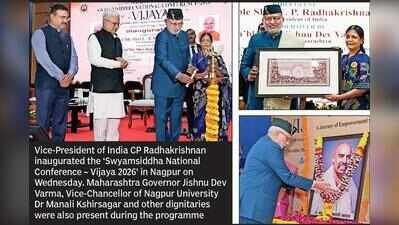
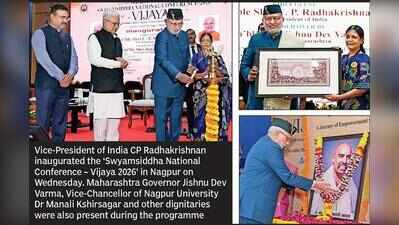
Nagpur: India has a long tradition of women leaders, with several queens delivering better governance than their male counterparts, Vice-President CP Radhakrishnan said on Wednesday. Radhakrishnan also recalled that 15 women members of the Constituent Assembly made valuable contributions to the framing of the Constitution, challenging the perception that women were historically denied opportunities to participate in public life.The Vice-President was speaking after inaugurating the Swayamsiddha National Conference 2026 on Women’s Empowerment, themed ‘Vijaya – A Journey of Empowerment through Education’, organised by the Swayamsiddha Centre of Nagpur University at NFSC Hall in Nagpur on Wednesday, on the eve of Constitution Day.Calling for greater participation of women in nation-building, he stressed that women’s empowerment must evolve into women-led development.“Indian history is full of queens who ruled better than many kings. From Jhansi Rani to Mangamma in Madurai, from the north to the south, there have been many such examples,” he said.Referring to the Constituent Assembly, Radhakrishnan said, “Many of us forget or don’t know that 15 women members played a key role in framing the Constitution. We sometimes think that women were not allowed to participate in politics back then. That is not correct.”Radhakrishnan said the proposed 33% reservation for women in the Lok Sabha and state legislatures through the Nari Shakti Vandan Adhiniyam would create greater opportunities for women to serve the nation. “It is our duty to prepare the girls and groom them as leaders,” he added.Highlighting women’s educational achievements, the Vice-President said he had consistently seen more female than male gold medallists at university convocations across the country, including in Srinagar, Thiruvananthapuram, Pune, Bhubaneswar and the Northeast.The Vice-President cited the All India Survey on Higher Education, pointing out that the female gross enrolment ratio in higher education increased from 23% in 2014-15 to 31.8% in 2023-24. Education, he said, was the most effective instrument for empowering women, enabling them to make informed decisions, secure employment, become entrepreneurs and participate in public life.Radhakrishnan said the Swayamsiddha initiative, which he had launched during his tenure as Maharashtra governor, was conceived to make universities active partners in human empowerment rather than limiting them to providing academic qualifications.He urged universities to ensure that women from rural and remote areas are not left behind. Access to education, digital facilities, career guidance and skill training could help bring them into the mainstream.Radhakrishnan emphasised that empowerment was a collective responsibility involving govts, educational institutions, industry, civil society and families. The success of Swayamsiddha, he said, would ultimately be reflected in the confidence, independence and leadership of the women it reaches.
About The Author