









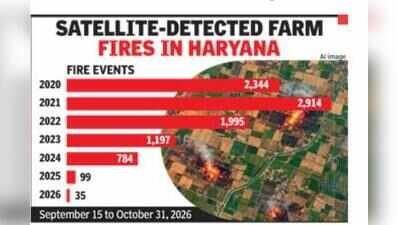
Gurgaon: Haryana recorded 35 satellite-detected paddy residue-burning events between Sept 15 and Oct 31, the lowest for the corresponding period in seven years. The state recorded a 65% decline in farm fires compared with the corresponding period last year, when 99 incidents were detected. The reduction was sharper against previous years, with the latest count 95.5% lower than the 784 events recorded in 2024, according to the latest district-wise satellite monitoring data.The city has reported zero satellite-detected farm fires in each of the seven years covered by the data. The data, based on satellite remote sensing under the standard protocol for estimation of crop residue-burning fire events, shows a sustained decline since 2021, when Haryana recorded 2,914 fires during the same period. The count fell to 1,995 in 2022 and 1,197 in 2023, before dropping to 99 in 2025 and 35 this year. The stubble-burning monitoring window runs from Sept 15 to Nov 30, and the latest figures provide an interim picture of the season, which is yet to conclude.Programme manager at EnviroCatalysts Jinitha Varghese said farmer engagement, machinery support, financial incentives and stronger enforcement adopted by Haryana had contributed to the decline in stubble-burning incidents. However, she cautioned that the next two to three weeks would be crucial, as peak harvesting and the short window before wheat sowing could lead to a rise in incidents. “Strengthening monitoring is equally important. Satellite-based detection should be complemented by real-time alerts and ground-level verification to ensure quicker response and more effective prevention,” she said.District-wise figures show that Palwal recorded the highest number of farm fires at seven, accounting for a fifth of the state’s total. Kaithal followed with four incidents, while Karnal, Kurukshetra and Yamunanagar recorded three each. Faridabad, Hisar, Jind, Panipat and Sonipat reported two incidents each. Fatehabad, Hansi, Panchkula, Rohtak and Sirsa recorded one each.Several districts reported no farm fires during the Sept 15 to Oct 31 period. These included Gurgaon, Nuh, Rewari, Mahendragarh, Charkhi Dadri, Bhiwani, Jhajjar and Ambala. The latest daily monitoring bulletin showed that six residue-burning events were detected in Haryana on Oct 31 alone, compared with 292 in Punjab. Rajasthan recorded 24 and Madhya Pradesh 10, while no incidents were detected in Uttar Pradesh, Delhi and Uttarakhand on the day.Across the seven states listed in the bulletin, 3,071 farm fires were detected between Sept 15 and Oct 31. Punjab accounted for 1,339, followed by Rajasthan (638), Madhya Pradesh (538), Uttar Pradesh (345), Uttarakhand (174), Haryana (35) and Delhi (two). The bulletin cautioned that cloud cover could obscure the detection of residue-burning events in parts of Uttar Pradesh, Madhya Pradesh and Uttarakhand.Meanwhile, an RTI filed by Noida-based Amit Gupta has revealed that 1,383 stubble-burning cases were reported across Punjab, Haryana, Uttar Pradesh and Delhi between Sept 15 and Oct 29. Punjab accounted for the highest number at 1,007, followed by Uttar Pradesh (345), Haryana (29) and Delhi (two), according to the response from Commission for Air Quality Management (CAQM).The RTI response also revealed that environmental compensation totalling over Rs 18 lakh was imposed in Punjab, Haryana and UP (NCR), of which Rs 13 lakh, or around 75%, was recovered. Punjab accounted for Rs 17.5 lakh of the compensation imposed, of which over Rs 13 lakh was recovered. Haryana imposed Rs 50,000 and recovered Rs 30,000, while UP (NCR) imposed and recovered Rs 17,500.The response showed that Punjab and Haryana together registered 8,917 FIRs related to stubble-burning violations between 2024 and Oct 29, 2026. Punjab registered 5,802 FIRs and Haryana 667 in 2024. The numbers declined to 1,963 and 230, respectively, in 2025. In 2026 up to Oct 29, Punjab registered 246 FIRs and Haryana nine, taking the combined count to 255.The RTI also raises a wider question about accountability for other sources of pollution across Delhi-NCR. Gupta had sought information from CAQM on action against violations related to road dust, construction and demolition activities, industrial emissions, waste burning, uncovered construction material, damaged roads and commercial establishments violating environmental norms.In response, CAQM transferred parts of the application under Section 6(3) of the RTI Act to the Haryana State Pollution Control Board, Delhi Pollution Control Committee and Uttar Pradesh Pollution Control Board for the relevant information. Their responses are awaited.Gupta has sought comparable information on violations detected, FIRs registered, environmental compensation imposed and amounts recovered from other sources of pollution, arguing that environmental accountability must extend beyond farmers to industries, construction agencies, waste-management violators and govt departments responsible for road maintenance and dust control.
About The Author