










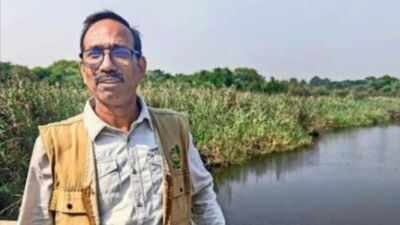
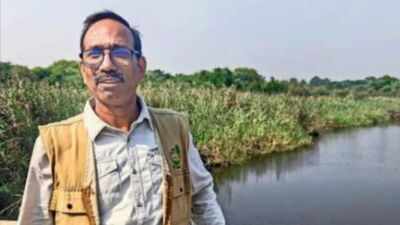
They are perched on faraway trees, hugging a bright and breezy waterbody. It’s a sharp sunny day, and you can clearly see the large black birds. “Those are Great Cormorants,” says biodiversity expert Faiyaz Khudsar, “and the one sitting alone on the rock is a Snakebird.”We are walking through the Yamuna expanse of Yamuna Biodiversity Park (YBP), near north Delhi’s Wazirabad, the site of a 14th century bridge built by Delhi Sultanate ruler Firoz Shah Tughlaq.Wazirabad is boisterous, bustling and unkempt. YBP is its opposite. At the park, you can hear the wind whistling, trees braced under our feet, and watch a Blue Pansy butterfly float by. You will also come across smoothways flanked by tall wild grass and trees laden with elephant apples — and gasp at the enormous size of beehives.Inhaling the grass-scented air and absorbing the picture-postcard greenery, it’s hard to believe that two and a half decades ago, the entire area was degraded land, highly alkaline, extremely saline and low on nutrients, where only salt-loving bushes and weeds grew. But a project, conceptualized in 2002 by noted ecologist R C Bahuguna, then pro-Vice Chancellor, Delhi University, and backed by Lt-Gov Vijay Kapoor, transformed the expanse into a thriving self-sustaining natural ecosystem.What made the project a rarity was the academic-administration collaboration between the Delhi University, the nodal authority and fully funds the programme, and Delhi University’s Centre for Environmental Management of Degraded Ecosystems (CEMDE), which provides scientific knowledge for YBP’s shaping and upkeep.Spread over 457 acres in Yamuna’s upstream, YBP is a mosaic of wetlands, grasslands and more. “Wetlands are to rivers what kidneys are to the body. They flush out the toxins, clean the water,” Khudsar points out. Then there is an extensive medicinal plant garden and a conservatory of butterflies that transports you to childhood.Numbers reveal the project’s expansive floral and faunal diversity. The park reserve is home to 1,017 plant species, 203 bird species, 82 kinds of butterflies, 18 types of reptiles and 22 species of mammals. Residents include hog deer, civet, wild hare and pig, nilgai and an itinerant leopard. Winter visitors include the cute Red Crested Pochard, which takes a long-distance flight from Siberia and Central Asia, and stays for about four months.Under the meticulous guidance of Prof R C Bahuguna, and a unique process, Khudsar says the site’s ecological history was examined in detail and efforts made to find its nearest possible equivalent. The entire Yamuna basin, nearly 1,400km in length, was surveyed.The environmental scientist explains how the salt-eating Leptochloa fusca, commonly known as brown-bottle grass, helped them win the war against saline soil. Soil fertility improved by using ‘dhaaincha’, a leguminous plant, often used as green manure. Following a bunch of other eco-friendly initiatives, land and water were rejuvenated. An ecosystem had found life after death.YBP became functional in 2012. It was savvily managed by CEMDE. In 2012, it saw biodiversity parks, including one in Aravalli. “Every bio-diversity park is constantly evolving,” says Khudsar, engaged with the biodiversity park programme for over 20 years.Khudsar was born in Kolkata but grew up in east-central Bihar’s Khagaria town. As a kid, he would visit the banks of Burhi Gandak with friends. “We would bathe in the river, catch shrimps,” he recalls.When 12, he would notice an aquatic animal often surface in the water. Neither his friends nor him could identify the creature. “Those were pure Google days,” he quips. But the animal’s golden tiny legs kept nagging him like an itch he couldn’t scratch. In 1992, as a postgraduate student of environmental biology in Delhi University on a field visit to Chambal river, he finally got the answer. “A professor identified the creature as a Gangetic dolphin,” he recalls.Rather than work on marine ecology, Khudsar followed the advice of Baloo, the department’s course coordinator, and decided to get field experience with an NGO, Tiger Trust, at Kanha National Park. “I learnt from Gond and Baiga tribes how forest communities handle natural resources,” he says.Between 1999 and 2004, Khudsar was based out of Kuno Wildlife Sanctuary, now a national park, working on his doctorate. “For a while, I lived with the Sahariya tribals, who were to be relocated, trying to understand their needs,” he remembers. Then considered an alternative site for lions, Kuno is now home to 57 cheetahs.It was a hard day’s life at Kuno. The research scholar would wake up in the morning, pack wheat flour, salt, onion and green chillies, along with his notes in the afternoon, he would knead the flour into a dough on a flat stone and bake a roti over drier cow dung or deer pellets. “But I managed to do a proper survey of the area,” quips Khudsar.Watching the 56-year-old scientist interact with a visiting group of eager tropical science students from Ambedkar University, it is evident he relishes the job. “I try to convey that as responsible citizens, they must be aware of the need to protect and preserve our precious natural resources. And that no matter which profession they undertake, they should become future conservationists in their own way,” he says.YBP gets about 100 visitors every day, including civil servant trainees. Entry, including a guide, is free. Do plan a visit this winter migrating birds like Northern Pintail come calling. Take the plush Pink Lake metro on a weekend. Get down at Jharoda Majra station. A five-minute e-rickshaw ride will take you there.The sight of dragonflies, water lilies, lime butterflies, and perhaps an oriental darter, will definitely restore you. And your lungs might even send you a ‘thank you’ note.
About The Author