








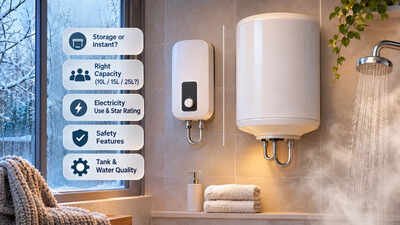
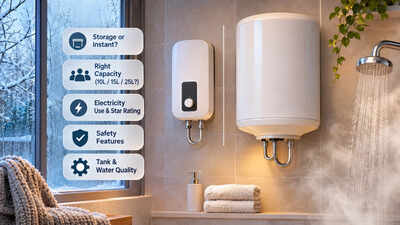
Winter mornings can be uncomfortable enough without having to wait for hot water or discover that your geyser cannot meet the family’s needs. Yet choosing a water heater is not as simple as picking one with a bigger tank or a higher star rating. A geyser that works well for a single person may struggle in a household where four people need hot water within an hour. Similarly, an instant geyser may be convenient for a small bathroom but may not be the best option for a family that uses large quantities of hot water. The right choice depends on how many people use it, how much hot water they need and how often the appliance runs. Here’s what to consider before spending money on a new geyser this winter.
1. Storage or instant geyser: Which one should you choose?
This is the first decision buyers need to make.Storage geysers heat water inside an insulated tank and keep it available for use. They are generally better suited to families, especially when several people need hot water one after another. Their biggest advantage is that they can store a supply of heated water. However, once that supply is used, the geyser needs time to heat another batch.Instant geysers, on the other hand, heat water as it flows through the appliance. They do not store a large quantity of hot water, making them compact and useful for smaller bathrooms, kitchens and limited usage.However, their output depends on the appliance’s heating capacity and water flow. A small instant geyser may not provide the same volume of hot water as a storage model.Which should you buy
- Choose a storage geyser if several family members use hot water regularly.
- Choose an instant geyser if you need hot water for a washbasin, kitchen or occasional use.
- Consider the available space and your home’s electrical setup before deciding.
2. 10-litre, 15-litre or 25-litre: What capacity is right for your family
For a storage geyser, these capacity ranges can serve as a starting point:
| Household size | Capacity to consider |
|---|---|
| One person | 6–10 litres |
| Two people | 10–15 litres |
| Three to four people | 15–25 litres |
| Five or more people | 25 litres or higher |
These are indicative ranges, not fixed requirements. Manufacturer buying guidance also recommends adjusting capacity according to bathing habits and the number of people using hot water around the same time.Also remember that a tank’s rated capacity is not the same as the quantity of water available at your preferred bathing temperature. Hot water mixes with cold water, and the usable quantity depends on the temperature setting and incoming water temperature.Our recommendation: If your family has three or four members and uses hot water around the same time, compare 15-litre and 25-litre models rather than automatically choosing the smaller option.
3. Check the BEE star rating before comparing prices
A geyser’s purchase price is only one part of its cost. Electricity consumption over several winters matters, too. The Bureau of Energy Efficiency (BEE) has included stationary storage-type electric water heaters in its mandatory star-labelling programme.But what does the rating actually tell you?For storage geysers, the BEE star rating is based on standing heat loss. This measures how much heat escapes from the stored water over a specified period. Better insulation helps the geyser retain heat for longer.A higher star rating indicates better performance against the applicable standing-loss criteria. However, it does not mean that a five-star geyser will always consume less electricity than every three-star model in every household. The amount of water heated, frequency of use and temperature setting also matter.Before buying:
- Compare the star ratings of models with similar capacities.
- Check the BEE label and its applicable label period.
- Look at the standing-loss figure, where available.
- Do not compare models solely on the number of stars.
4. How much electricity does a geyser actually consume
Wattage can help you understand how quickly a geyser heats water, but it should not be confused with total electricity consumption.A 2,000W geyser draws 2 kilowatts of power when operating at its rated load. A 3,000W model draws 3 kilowatts. The higher-wattage model can generally heat the same quantity of water faster under comparable conditions. But it also draws more power while running.A higher-wattage model may reduce waiting time, but it also needs an electrical circuit that can safely support its rated load. Check the wiring, circuit protection and manufacturer’s installation requirements before buying.
5. Don’t compromise on safety features
A geyser combines electricity, water and heat. Its safety features deserve as much attention as its capacity and price.Check for:
- Thermostat: Regulates water temperature and controls heating.
- Thermal cut-out: Helps disconnect power if the temperature exceeds the permitted limit.
- Pressure-relief valve: Helps release excessive pressure inside a closed storage tank.
- Proper earthing: Reduces the risk of electric shock when combined with appropriate electrical protection.
- BIS certification: Check the applicable standard and certification details.
The Bureau of Indian Standards lists IS 2082:2018 for stationary storage-type electric water heaters and IS 302 (Part 2/Sec 35):2017 for instantaneous electric water heaters. Its certification framework also includes electrical safety requirements.Do not rely only on marketing terms such as multi-level protection. Check the actual safety components and get the appliance installed by a qualified technician.
6. Live in an area with hard water? Check the tank material
Water quality can affect a geyser’s maintenance requirements and lifespan. In areas with hard water, mineral deposits can build up inside the tank and around the heating element. This may affect heating performance and increase the need for servicing.Before purchasing, check whether the model offers:
- A glass-lined or enamel-coated inner tank.
- A corrosion-resistant heating element.
- An anode rod designed to help protect the tank against corrosion.
- Manufacturer-recommended maintenance and descaling support.
No single tank material is automatically suitable for every water supply. Check the product specifications and warranty conditions, particularly if your area has high mineral content.
7. Compare warranties and installation costs
A low purchase price does not necessarily make a geyser the best deal.Compare the warranty on three components separately:
- Inner tank
- Heating element
- Electrical and other product components
These can have different warranty periods. Also check whether installation is included, whether connecting pipes and valves cost extra, and whether the manufacturer has authorised service support in your city.A model with a slightly higher purchase price may offer better long-term value if it comes with suitable warranty coverage and accessible servicing.Which geyser should you buy this winter
Final checklist before buying
- Is the geyser’s capacity suitable for your household?
- Have you compared storage and instant models?
- Have you checked the BEE star label, where applicable?
- Is the wattage suitable for your electrical setup?
- Does the appliance have the required safety features?
- Is it BIS-certified under the applicable standard?
- Is its pressure rating suitable for your building?
- Does it offer adequate corrosion protection for your water conditions?
- Have you compared tank and heating-element warranties?
- Is authorised installation and servicing available?
The bottom line: Don’t buy a geyser simply because it has a bigger tank, higher wattage or more stars. A compact instant model may be sufficient for occasional use, while a family of four may benefit from a 15-litre or 25-litre storage geyser.
About The Author