









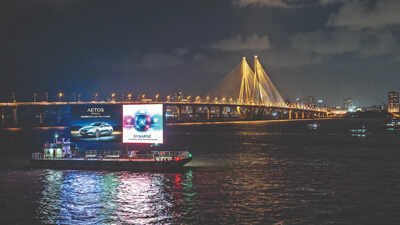
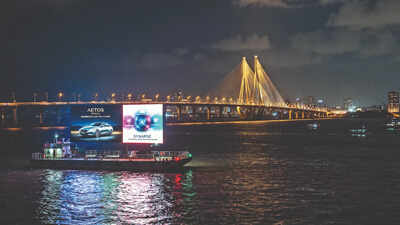
MUMBAI: Seven years after New York banned floating digital billboards from its rivers, calling them a public nuisance and a hazard, Maharashtra Maritime Board is clearing the decks to introduce them to Mumbai.The board has plotted 20 coastal locations-including Juhu Beach, Lotus Jetty at Worli and Bandra Sea Link Jetty-for shore-based and floating billboards, pushing Mumbai’s marketplace into Arabian Sea and simultaneously dragging a terrestrial crisis out to water: light pollution.Light pollution has escalated into a global environmental and public health crisis. Studies have shown it leads to poor sleep, mood disorders and increased risk of obesity and cardiovascular diseases in humans, and alters plant growth and disrupts natural behaviour and ecological interactions in animals.Its impact on coastal and marine ecosystems, an overlooked field, is now beginning to be studied. Landmark research by UK-based Plymouth Marine Laboratory and University of Plymouth found that roughly 22% of the world’s coastal waters are consistently exposed to artificial light at night, from sources such as streetlights, fishing boats and oil rigs. This light, especially from white or blue-rich LEDs, can penetrate up to 40m of the water column and disturb behaviours and biological processes in organisms adapted to the dark-such as plankton, says Minu Agarwal, assistant professor at CEPT University and founding member of DarkSky India.“Many zooplankton species spend daylight hours in deeper waters, rising towards the surface after sunset to feed under the cover of darkness,” says Agarwal. This daily migration, among the largest movements of living organisms on Earth, is orchestrated by light. Artificial illumination can interrupt it, changing where organisms feed, how they evade predators and, ultimately, how energy moves through the marine food web.Marine light pollution research in India has largely focused on the ecological impacts of ‘LED fishing’-an illegal form of fishing that creates an artificial food chain that draws organisms from plankton to predators to illuminated nets, disrupting marine migration and feeding habits.Studies have also centred on the disorienting effects of artificial light on Olive Ridley turtles, that draw hatchlings inland towards urban light sources and away from the sea. An Olive Ridley turtle sighting on Juhu beach last year briefly raised hopes for their mass return but also underscored a bleak environmental reality: the loss of Mumbai’s ancestral nesting sites to crowded, brightly lit beaches.As a signatory to Convention on the Conservation of Migratory Species of Wild Animals (CMS), India has a moral obligation to ensure their safe passage and should follow the guidelines on light pollution, says Shweta Kulkarni, a dark sky strategist who has been working with the Maharashtra govt to formulate a dark sky policy. A resolution to frame guidelines on light pollution for migratory wildlife, including marine turtles and seabirds, was endorsed in India itself, at Conference of the Parties (CO) to CMS, held in Gandhinagar in 2020. The guidelines, formalised four years later, recommended a 20km light-free buffer around important wildlife habitats and called for an environmental impact assessment of proposed illuminated sites.Mumbai, the city that never sleeps (because the lights are always on), already has high levels of light pollution. “Satellite monitoring confirms that Mumbai’s nearshore waters far surpass the threshold (1.2 nanoWatts/sr/cm^2) that delineates pristine marine habitats, pushing local coastal waters into chronic pollution zones,” says Vishal Bhave, assistant director (marine conservation) at Srushti Conservation Foundation. Introducing floating commercial billboards directly into this sensitive intertidal zone adds concentrated, high-radiance beacons right at the waterline, completely erasing natural marine dark corridors, he explains.There are ways to reduce coastal light pollution, if not avoid it altogether, suggests Mathi Thumilan, co-founder of Wild and Dark Earth, that has been working to create awareness on light pollution and conserve nocturnal habitats in wild and urban areas. “Simple fixes, like switching from blue to warm spectrum light, restricting brightness and installing timers to gradually reduce intensity beyond our active hours, can help,” he says.But the best way to tackle light pollution is to prevent it before it becomes unmanageable, like air and water pollution, he adds. “Billboards are revenue generators, after all; it’s only a matter of time before dozens crowd the water. We won’t just stop at one.”(With inputs by Hemali Chhapia)
About The Author