










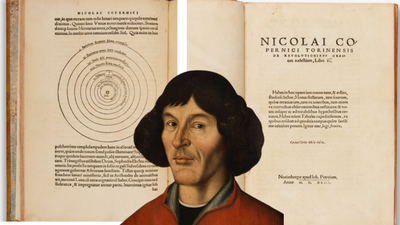
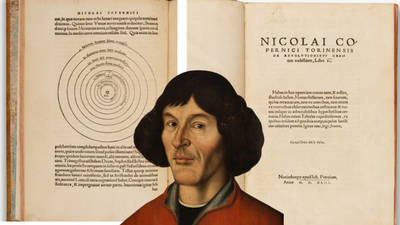
In 1543, Nicolaus Copernicus published a book that challenged the long-held belief that Earth stood at the centre of the universe. On October 20, 2026, a first edition of that work sold for $2.304 million at Sotheby’s in New York, more than twice its high estimate of $1 million. The book, ‘De revolutionibus orbium coelestium,’ was printed in Nuremberg in 1543 by Joannes Petreius. According to the official website of British auction house Sotheby’s, it had estimated the rare first edition at $700,000 to $1 million. As reported by Rare Book Hub, the final price was $2.304 million, making it the highest-selling lot in the auction.
The book that changed how people understood the solar system
Copernicus’s work presented the heliocentric model, which placed the Sun at the centre of the planetary system rather than Earth. It proposed that Earth rotates on its axis and moves around the Sun, challenging the geocentric model associated with the ancient astronomer Ptolemy, which had shaped astronomical thinking for centuries. According to Sotheby’s, the book offered a different way to understand Earth’s place in the cosmos. Its ideas provided a foundation for later astronomers to test, refine and develop more precise explanations of planetary motion.The book’s title translates as ‘On the Revolutions of the Heavenly Spheres.’ Copernicus did not simply change the position assigned to Earth; his model challenged the assumption that the planet was stationary. The proposal that Earth itself moved required astronomers to reconsider observations that had long been interpreted through an Earth-centred system.According to Sotheby’s website, the 1543 publication was a landmark in the history of scientific thought. In an article published ahead of the auction, the house explained how the work helped establish a new way of calculating the positions and movements of planets. Later developments in astronomy built on the questions and calculations that Copernicus’s model brought into focus.
A rare first edition outperforms its estimate
The copy was offered as part of Sotheby’s sale titled ‘Reason and Revolution: Extraordinary Works from a Distinguished Private Collection, Part 1,’ held in New York on October 20, 2026. The auction brought together historical scientific works associated with the development of astronomy and physics.Rare Book Hub recorded the Copernicus book as lot 10, with an estimate of $700,000 to $1 million and a final price of $2.304 million. The result was more than 2.3 times the high estimate. Other works in the same sale included a first edition of Isaac Newton’s ‘Philosophiae naturalis principia mathematica,’ published in 1687, which sold for $768,000, and Galileo Galilei’s ‘Sidereus nuncius,’ published in 1610, which sold for $576,000, according to Rare Book Hub. Both also exceeded their estimates.
About The Author