










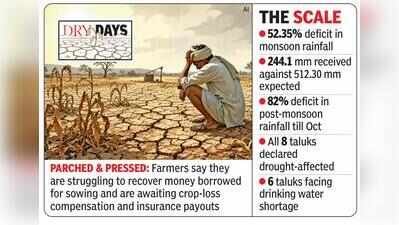
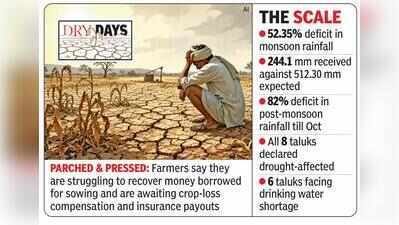
Haveri: A severe monsoon failure has pushed Haveri district into a deep agricultural crisis, with crop losses estimated across more than 3.4 lakh hectares and 2,92,425 farmers affected. A joint crop-loss survey conducted by officials has assessed the damage at Rs 386.01 crore, and the district administration has submitted a detailed report to the state govt seeking compensation for farmers.Drought has hit more than 3.4 lakh hectares in Haveri district, affecting 2,92,425 farmers, with crop loss assessed at Rs 386 crore.Officials conducted a joint crop-loss survey to assess the damage, after which the district administration submitted a detailed report to the state govt seeking compensation for farmers.Officials declared all eight taluks drought-affected after a 52.3% rainfall deficit during the 2026–27 monsoon season. Against an expected 512.3mm, the district received just 244.1mm.Officials said poor rainfall severely affected almost all major sown crops, cutting yields and leaving farmers struggling to recover input costs.The crisis has deepened, with post-monsoon rainfall down 82% through Oct, raising concerns about summer crops. Agriculture-dependent families face uncertainty over income, loan repayment and preparations for the next cropping season.Farmers’ organisations have urged the govt to expedite crop-loss compensation and crop insurance payments.“Haveri district is facing a severe drought this year. Farmers are not even recovering the money they borrowed and spent on sowing. They are in deep distress. The govt must immediately provide crop-loss compensation and crop insurance payouts to support them,” said Bhuvaneshwar Shidlapur, farmers’ leader.Drinking water shortages have also emerged in six taluks. In other taluks, water is being supplied through private borewells, except in Haveri and Ranebennur.Officials said 50 private borewells have been hired on a rental basis to supply water to 42 villages under 34 gram panchayats. Authorities are taking precautionary measures to prevent the crisis from worsening in the coming months.“Immediate relief and planning are essential to protect both farmers and rural households from further hardship,” Shidlapur said.
About The Author