










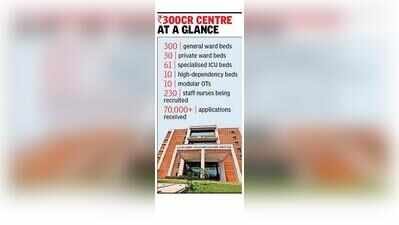
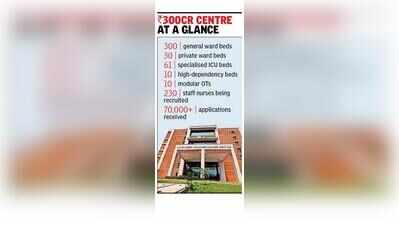
Chandigarh: Six months after launching OPD services, PGI’s state-of-the-art Advanced Neuroscience Centre is yet to admit its first inpatient, with a shortage of nursing staff emerging as the key hurdle in making the Rs 300-crore facility fully operational.The centre began OPD services in April and was virtually inaugurated by Prime Minister Narendra Modi in July. Officials said preparations are now under way to start inpatient services in phases, with the first beds expected to become operational after new nurses join in January.Besides manpower, several operational arrangements have to be put through dry runs before patients can be admitted. These include patient diets, laundry and clean linen services, besides deployment of ward attendants, operation theatre technicians and nurses.A CT scan machine has already been installed, while the MRI facility is expected to become operational in Jan.The recruitment of 230 staff nurses is under way, with PGI receiving more than 70,000 applications. The entrance examination is scheduled for Nov 18 at multiple centres, including in Uttarakhand, while results are expected in the last week of Dec. The recruitment timeline is expected to allow selected nurses to join in Jan.In the interim, PGI plans to start a five-to-10-bed neurology day-care service, where patients requiring short-stay procedures such as intravenous injections and IVIG treatment can be managed.“To bridge the gap and test operational readiness, the department is launching a 5-to-10-bed neurology day-care service following Diwali. This initial phase will cater to patients requiring short-stay procedures such as intravenous injections and IVIG treatments, enabling the administration to refine critical workflows, including dietary and laundry logistics,” a PGI spokesperson said.The centre’s central sterile supply department is already operational and is supporting the main PGI during ongoing hospital renovations.Once the new nurses join, PGI plans to open inpatient services in phases, beginning with 25 neurosurgery and 25 neurology beds, before scaling up to full capacity by March 31.The Advanced Neuroscience Centre has 300 general ward beds, 30 private ward beds, 61 specialised ICU beds, 10 high-dependency beds and 10 modular operation theatres. It also houses a “Brain Suite” equipped with real-time intraoperative imaging.
About The Author