










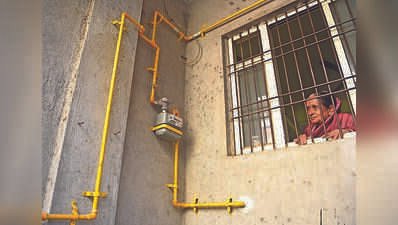
Noida: For JS Bhadana, moving from LPG cylinders to piped natural gas (PNG) was meant to make life easier. Instead, the resident of Diya Green City in Raj Nagar Extension has spent four years going back and forth between the builder and Indraprastha Gas Limited (IGL), waiting for a connection.“I was already done with gas cylinders, paying the delivery boy an extra charge, going online and booking the cylinder every month,” Bhadana said. “We are growing old, and it is a bit strenuous to connect to the pipeline and attach a gas cylinder.”Bhadana moved into his flat in 2024, paying the builder more than Rs 15,000 in possession-related charges that were meant to cover the gas connection and the infrastructure to lay the pipeline. When he approached IGL, its team inspected the society and then sent him back to the builder, who said connections would only follow once occupancy reached around 30%. Pipelines have since been laid inside the society. But his flat, still, awaits one.Govt is pressing for conversion of LPG connections to PNG amid tensions around the Strait of Hormuz. Residents say the appeal of PNG is straightforward — a continuous supply, with no booking, no waiting for delivery, no hauling cylinders up staircases.But across Noida and Ghaziabad, families who have filled out applications, sat through verification and paid their connection charges have found themselves waiting for years regardless, stalled by missing pipelines, unresolved ownership papers, thin occupancy figures, or builders who never built the infrastructure they promised. There is no fixed timeline for the wait, and, residents say, no one is clearly accountable for it.According to an IGL official, consumers can apply for a PNG connection through the company’s website or customer care service, providing details of their accommodation and address. An inspection follows. “Within six to seven working days, we then send our team to inspect the area, check the availability of the pipeline and assess all the requirements,” the official said.But this is often where things stall. If the network has not reached the area, IGL first determines whether it can be extended at all, and what that would require.Amartya Sinha, a resident of Krishna Homes in Jalpura, Greater Noida West, said he has been waiting nearly two years. “When I applied for the connection, a verification was conducted and the officials told us that the connection in the area was difficult and that it lacked infrastructure. For two years, nothing changed,” he said.Sonu Yadav, who owns an independent house in Noida’s Sector 73, has watched highrises built directly across from his home receive connections while his application has gone nowhere. “I have just been doing the rounds of the IGL offices and have written letters to everyone possible, but the connection has not reached my home,” he said. Each time, Yadav was told there was simply no pipeline in his area.Even a nearby pipeline offers no guarantee. The company must also confirm that the locality is authorised to receive the network, sometimes seeking verification from Noida Authority. “In the past, when we have received requests from residents, we have had to verify from the Noida Authority whether the area is authorised,” a senior IGL official in Noida said.IGL also weighs how many flats are actually lived in before deciding whether to extend a network, the official said.“In some cases, especially in newly built societies, when we check the occupancy rate, we find that only a few have shifted. In such cases, pushing for the pipeline infrastructure becomes a problem,” the senior official said, describing a standoff in which residents want gas before they move in while the company wants residents in place before it invests in infrastructure, with flats in some towers sitting empty long after possession begins, freezing the process altogether.Where a pipeline does exist, the process shifts to paperwork. Consumers have to submit ownership and registry documents, and here too, delays creep in, particularly for those holding an ownership certificate for a property not yet formally registered in their name.Once the paperwork is cleared, consumers can make the payment. The connection charge is generally around Rs 7,000, though it may vary. The company also offers an EMI facility, allowing consumers to pay around Rs 275, with the balance adjusted through subsequent gas bills.Even payment is no guarantee of imminent supply. For residents of highrise societies, the final stretch, actually getting the pipeline inside the complex, can prove the hardest.IGL needs the builder or maintenance body to provide access and dig the trenches required to carry the line in. “If the infrastructure is not there or the builder has not provided the necessary infrastructure for the pipeline, we cannot move ahead,” the IGL official said.Officials said this remains a hurdle in developing areas such as parts of Crossings Republik and Raj Nagar Extension, and precisely the reason why Bhadana’s family has been caught between a builder and a utility.Even after permissions and infrastructure are in place, residents may have to wait for the pipeline to be laid. IGL officials said construction conditions, particularly during the monsoon, can affect the schedule. “There is no fixed time. It can take six months for us to give a connection, and in some exceptional cases, when the infrastructure is all ready, it can be given in three to four days as well,” the senior IGL official said.Not everyone is left waiting. In Lotus Villa, residents credit a proactive RWA for a comparatively swift outcome. Mahipal Singh, a resident of the Greater Noida society, received his PNG connection in May, roughly two months after applying. “The RWA took the initiative after several residents approached them and asked them to start the facility. They brought all the forms to our homes. Within a week, an inspection was conducted and we got the connection,” Singh said.Digvijay Shukla, the RWA’s president, said the society sits around 300 metres from an existing pipeline. “IGL officials approached us, and we submitted the details of interested residents,” he said. “After verification and inspection, the pipeline was laid, and within two months we got the connections.”District officials, meanwhile, describe their role as largely supervisory, with primary responsibility resting squarely with IGL.Ghaziabad district supply officer (DSO) Amit Kumar Tiwari said the administration steps in mainly when individual complaints reach the district magistrate’s office. “If a consumer who wants a connection approaches the DM or me, I call IGL and ask them to look into the process and ensure that the person gets the connection,” he said. “Otherwise, it is solely the responsibility of IGL to provide the connection.”Ghaziabad currently has around 4.25 lakh PNG connections, with capacity for roughly 1.75 lakh more. In neighbouring GB Nagar, IGL provides about 4.5 lakh domestic connections, with room for another 1.5 lakh.GB Nagar DSO Smriti Gautam said her office sits on a committee that reviews IGL’s reports on infrastructure expansion and can escalate written complaints on residents’ behalf. But responsibility for actually delivering, and later monitoring, the connections, she said, remains with the company alone.
About The Author