









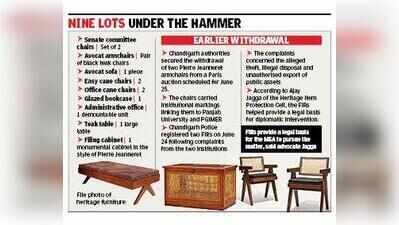
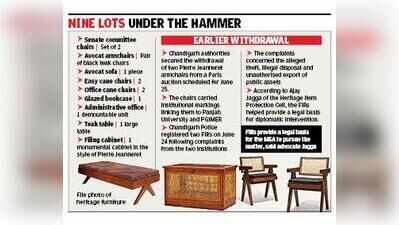
Chandigarh: With nine lots of Chandigarh heritage furniture scheduled to be auctioned in France on Oct 25, the UT department of cultural affairs has approached Chandigarh Police to register an FIR, initiate recovery proceedings and prevent the unauthorised sale of the city’s architectural legacy abroad.In a letter to the senior superintendent of police (SSP) on Oct 19, the director of cultural affairs flagged the proposed auction by Paris Oise Enchères in Chantilly, France. The department said the auction catalogue identified several pieces as originating from Chandigarh’s administrative buildings, raising concerns over their removal and sale overseas.“We are registering a case,” SSP Chandigarh said.The nine lots comprise a set of two Senate committee chairs, a pair of black teak “Avocat” armchairs, an “Avocat” sofa, two easy cane chairs, a glazed bookcase, two office cane chairs, a demountable administrative office, a large teak table and a monumental filing cabinet in the style of Pierre Jeanneret.Most of the furniture is attributed to Jeanneret, the Swiss-French architect and designer who worked with Le Corbusier on Chandigarh’s planning and architecture. The catalogue dates several pieces to the 1950s and 1960s.The department described the furniture as an integral part of Chandigarh’s documented heritage inventory and modernist architectural legacy. It urged the police to register an FIR and initiate recovery proceedings, stating that the removal and sale of such articles abroad was “prima facie illegal and criminal in nature”.Ajay Jagga, a member of the Heritage Item Protection Cell (HIPC), said registration of an FIR would provide a basis for diplomatic intervention. The ministry of external affairs could then take up the matter with the Indian embassy in France and seek appropriate action to halt or postpone the auction, he said.The proposed sale comes months after Chandigarh authorities secured the withdrawal of two Pierre Jeanneret armchairs from a Paris auction scheduled for June 25. The chairs carried institutional markings linking them to Panjab University (PU) and the Postgraduate Institute of Medical Education and Research (PGIMER).On June 24, Chandigarh Police registered two FIRs following complaints from PU and PGIMER authorities over the alleged theft, illegal disposal and unauthorised export of public assets. The cases were registered under Sections 305(e), relating to theft of property belonging to a government or local authority, and 61(2), concerning criminal conspiracy, of the Bharatiya Nyaya Sanhita (BNS).According to Jagga, the FIRs provided a legal basis for the ministry of external affairs to pursue the matter, leading to the chairs’ withdrawal shortly before the auction.The Chandigarh administration has maintained that heritage furniture forming part of the city’s institutional and architectural legacy cannot be removed or transferred without authorisation.A ministry of home affairs order dated Feb 22, 2011, cited in connection with the protection of Chandigarh’s heritage articles, prohibits their movement outside India and restricts transfers even between government buildings without due approval.“The latest complaint signals another attempt by the administration to use criminal proceedings and diplomatic channels to prevent Chandigarh’s heritage furniture from entering private collections overseas,” Jagga said.Box: 9 lots under the hammer–Senate committee chairs: Set of 2–Avocat armchairs: Pair of black teak chairs–Avocat sofa: 1 piece–Easy cane chairs: 2–Office cane chairs: 2–Glazed bookcase: 1Administrative office: 1 demountable unitTeak table: 1 large tableFiling cabinet: 1 monumental cabinet in the style of Pierre JeanneretEarlier withdrawal–Chandigarh authorities secured the withdrawal of two Pierre Jeanneret armchairs from a Paris auction scheduled for June 25.–The chairs carried institutional markings linking them to Panjab University and PGIMER–Chandigarh Police registered two FIRs on June 24 following complaints from the two institutions–The complaints concerned the alleged theft, illegal disposal and unauthorised export of public assets–According to Ajay Jagga of the Heritage Item Protection Cell, the FIRs helped provide a legal basis for diplomatic intervention.
About The Author