









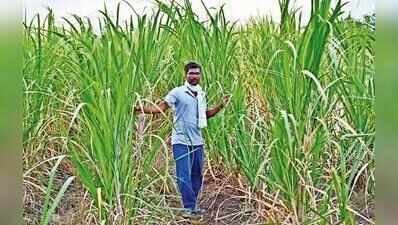
Beed: Vivek Sasawade’s sugarcane field looks scorched by the sun. The stalks are stunted, almost unable to hold up the withered leaves. With a 40% rain deficit in Marathwada’s Beed district this year, his field did not stand a chance against the fierce drought that has swept across the state.“I am looking at a 50% loss this year. Sugarcane needs to be watered every fortnight,” says Sasawade from Udand Wadgaon village.Acres of sugarcane fields are the ironic reality of Marathwada: a water-guzzling crop grown in a historically arid zone. The rain-dependent region accounts for 27.5% of the state’s sugarcane cultivation.And the crop’s base is expanding. The area under sugarcane in Marathwada has shot up by as much as 36% (one lakh hectares) in the five-year period between 2021-22 and 2025-26. The area expanded from 2.8 lakh hectares to 3.8 lakh hectares during this period, according to data from the state’s agriculture department.Marathwada has as many as 68 sugar factories accounting for 32% of the 208 factories in the state.The cane expanse in the region has come under scrutiny as the state faces one of its most widespread droughts, with 86.6% of talukas affected. Marathwada is among the worst hit with all 76 talukas impacted.Water experts like Pradeep Purandare have long called for a halt to sugarcane cultivation in Marathwada. He warns that it is resulting in the “desertification” of an already arid region since the crop mainly relies on the extraction of groundwater. Instead, he advocates the cultivation of pulses and oilseeds which are more drought-resistant.On average, 1 kg of sugar requires about 1,500–2,000 kg of water, says a 2020 NITI Aayog report of the task force on the sugar industry.“Water used to irrigate a hectare of sugarcane can irrigate 5.5 hectares of rabi jowar. This crop should not be cultivated in a drought-prone region with little irrigation,” says Purandare, former associate professor at the Water and Land Management Institute.He also calls for the implementation of the Maharashtra Irrigation Act 1976 which has remained without statutory rules for five decades. The Act empowers govt to curb the cultivation of water-intensive crops like sugarcane during acute water scarcity.Farmers from the region say they prefer to grow cane because it enjoys a minimum support price in the form of the Fair and Remunerative Price (FRP) set by the Centre.Plentiful rain in recent years in Marathwada has boosted cane cultivation. “It is an easy crop to manage if there is water. The crop can be grown for 3 years. You don’t even have to harvest it. That work is done by the cane-cutters paid by sugar factories,” says farmer Sasawade from Udand Wadgaon village.Critics say politicians also encouraged the expansion of sugarcane in Marathwada in an attempt to cultivate a vote base among the farmers. The ethanol blending push has also given factories a market for excess sugarcane.This year, the drought has also singed sugar factories. “Since the cane productivity is low, the sugarcane crushing season is expected to last only three months instead of six months. The factories will make less money but will have to pay farmers the FRP. We have asked the government for a subsidy,” says managing director of the Maharashtra State Cooperative Sugar Factories Federation, Sanjay Khatal.Meanwhile, farmers like Sasawade predict that sugarcane cultivation in Marathwada will dip next year. “Most of us will not grow cane. It is a risk because of the drought this year. I am going to switch to soyabean and tur dal,” he says.
About The Author