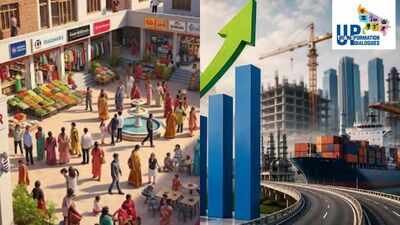










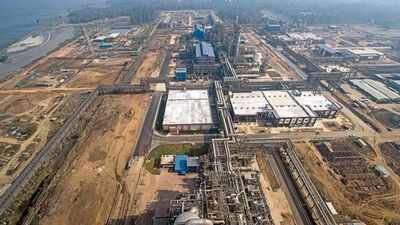
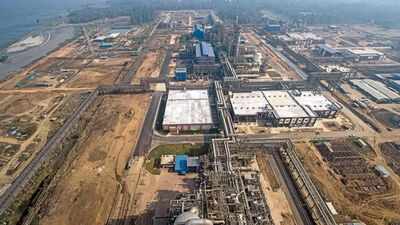
For decades, Gorakhpur carried the image of a city with considerable economic potential but an industrial base that had not fully realised it. The closure of the old fertiliser plant, limited large-scale manufacturing and inadequate industrial infrastructure constrained the city’s economic expansion. Over the last nine years, however, Gorakhpur has been witnessing a significant change in its economic profile, with industry, infrastructure, healthcare, education and connectivity developing together.The transformation is particularly visible in and around the Gorakhpur Industrial Development Authority (GIDA) area, which has increasingly become the centre of the district’s industrial expansion. According to Invest UP, industrial investment in Gorakhpur reached Rs 11,618.75 crore between 2017 and 2025, compared with Rs 29.33 crore during 2012–17. GIDA had 319 operational units generating 39,448 jobs, according to the same state investment-promotion material.The return of large-scale industryOne of the most significant milestones was the revival of Gorakhpur’s fertiliser manufacturing capacity. The old plant had remained closed for more than three decades. The new gas-based fertiliser plant, developed at an investment of around Rs 8,600 crore, was commissioned in December 2021. It has an annual capacity of 12.7 lakh metric tonnes of neem-coated urea.The project has significance beyond fertiliser production. Its operation creates demand for transportation, logistics, maintenance, services and ancillary businesses, while its location in eastern Uttar Pradesh strengthens the industrial base of the Purvanchal region.The revival also symbolised a broader change in the approach to Gorakhpur’s industrial development: large anchor projects are increasingly being accompanied by industrial estates, MSME clusters and supporting infrastructure.GIDA emerges as an industrial engineGIDA has become a major platform for this expansion. The authority has attracted investments across food processing, beverages, dairy, manufacturing and other sectors. Among the investments highlighted by Invest UP are projects by Keyan Industries, Varun Beverages, Ankur Udyog and India Auto Wheels, alongside plans for Plastic and Garment Parks.The industrial ecosystem is also becoming more accessible to smaller enterprises. In 2026, 34 companies were allotted industrial plots in GIDA with proposed investment of more than Rs 218 crore and employment potential of about 1,650 jobs, according to a report citing GIDA-related information.Another important development is the flatted factory complex, designed to accommodate MSME units in a relatively compact industrial format. The second such complex in Uttar Pradesh was inaugurated in GIDA in 2026, with space for 80 MSME units and an estimated employment potential of around 1,000 people.These initiatives point towards a more diversified industrial structure in which large companies and smaller entrepreneurs can operate within the same regional ecosystem.A new industrial geographyGorakhpur’s next phase of expansion is also extending beyond the established GIDA area. An industrial corridor along the Gorakhpur Link Expressway and the proposed Dhuriyapar Industrial City are intended to create additional space for manufacturing and investment. Invest UP has reported plans for an 800-acre industrial corridor along the expressway and a large land bank for the Dhuriyapar industrial area.This is important because industrialisation requires more than individual factories. It requires planned land, roads, utilities, logistics, housing and services. The expansion of the industrial geography around Gorakhpur seeks to create precisely such an ecosystem.GIDA’s current master-planning activity also indicates that industrial expansion is being treated as a long-term process rather than a collection of individual projects.Connectivity strengthens the investment propositionInfrastructure has been another important component of Gorakhpur’s changing economic profile. State investment-promotion material reports Rs 7,486.89 crore spent on construction of 1,492 km of roads in the district during the period covered by its assessment. Projects cited include the Jungle Kauria–Sonauli four-lane highway, Gorakhpur Greenfield Bypass, the TP Nagar–Padley Ganj six-lane flyover, the Pipraich–Gorakhpur four-lane road and the Gorakhpur Link Expressway.Improved road connectivity reduces the logistical distance between factories, markets and suppliers. For an eastern UP city positioned close to Bihar and Nepal, this has particular economic significance.Air connectivity has expanded as well. Passenger movements at Gorakhpur Airport rose from 6.02 lakh in 2021–22 to 10.02 lakh in 2025–26, according to Airports Authority of India data. A new terminal building has also been proposed, with the state government acquiring 42.14 acres for the project.Beyond factories: a broader economic ecosystemThe transformation is not limited to industrial investment. Gorakhpur has simultaneously expanded its healthcare and education infrastructure. The commissioning of AIIMS Gorakhpur alongside the fertiliser plant in 2021 added a major tertiary healthcare institution to eastern Uttar Pradesh. The same development package included the new building of the ICMR Regional Medical Research Centre.Education infrastructure has also expanded, with new institutions and facilities strengthening Gorakhpur’s position as an educational centre. State investment material identifies a Sainik School, Atal Residential School, government colleges, ITIs and polytechnic institutions among the newer components of the district’s education ecosystem.Together, healthcare and education contribute to the emergence of a more diversified urban economy, generating demand for housing, retail, transport, professional services and other activities.From regional centre to growth centreGorakhpur’s transformation over the past nine years is therefore best understood not through a single project but through the convergence of industrial investment, infrastructure, connectivity, healthcare, education and planned urban expansion.The fertiliser plant restored a major industrial anchor. GIDA has created a platform for large companies and MSMEs. New industrial areas are expanding the city’s economic geography, while roads, the expressway and aviation connectivity are improving access to markets. At the same time, AIIMS and educational institutions are strengthening the human-development side of the regional economy.The challenge ahead will be to convert investment announcements and industrial land into sustained production, employment and local supply chains. The continued expansion of GIDA, Dhuriyapar and the expressway-linked industrial areas will be important in determining how deeply this transformation reaches into the wider Purvanchal economy.Gorakhpur’s story, therefore, is increasingly one of economic diversification. A city once constrained by the legacy of industrial closures is developing the infrastructure and institutional base required for a broader manufacturing, services and logistics economy. Its emergence as a growth centre could have implications well beyond the district, given its strategic position as a gateway to eastern Uttar Pradesh, Bihar and Nepal.
About The Author