




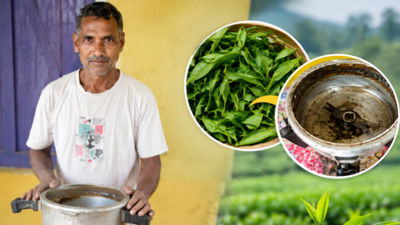
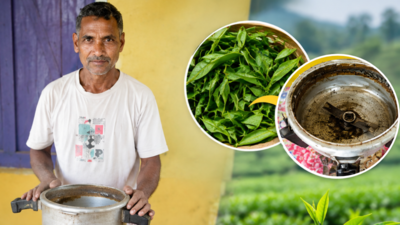
An old pressure cooker and a household mixer-grinder may seem unlikely tools for making tea. But for 51-year-old farmer Ratan Ray from Assam, these everyday appliances became the foundation of an improvised machine designed to solve a practical problem faced by small tea growers: the high cost of specialised processing equipment.Ray, who lives in Choibari, Hindupara, in Dhubri district, has spent 25 years cultivating tea. His experience helped him recognise the difficulties small growers face when they want to process tea leaves without investing in expensive machinery. Instead of relying entirely on conventional equipment, he repurposed an old pressure cooker, connected it to a mixer-grinder motor and fitted specially designed metal blades inside it.According to the Indian Council of Agricultural Research (ICAR), the resulting device can crush, tear and curl tea leaves into small pellets, replicating key stages of the Crush, Tear and Curl (CTC) method used in tea manufacturing.
How a pressure cooker became a tea-processing machine
Ray’s innovation is based on adapting household appliances for a purpose they were not originally designed to serve. He fitted metal blades, similar to those used in conventional tea-processing equipment, inside the pressure cooker and connected the assembly to the motor of a regular mixer-grinder.The modified machine enables tea leaves to undergo the crushing, tearing and curling stages of processing. These steps help turn freshly harvested leaves into the small granules associated with CTC tea, a popular variety in which the processed leaves are broken into smaller particles that brew relatively quickly.The idea addresses a specific challenge for small growers: accessing equipment that can mechanise tea processing without requiring the investment associated with dedicated industrial machinery.By mechanising part of the process, Ray’s device reduces dependence on traditional manual rolling methods and can speed up processing. The uniform grinding action may also help improve consistency in the finished product.Ray says the tea produced using his machine has a stronger flavour and brews faster, qualities preferred by local consumers who favour CTC tea.
Why the idea matters for small tea growers
Tea processing involves more than growing and plucking leaves. The way harvested leaves are processed influences the form, consistency and brewing characteristics of the finished tea. For growers who have limited resources, the cost of acquiring specialised machinery can become a barrier to processing their produce efficiently.Ray’s experiment offers a possible alternative by using appliances that are readily available rather than relying exclusively on purpose-built equipment. Its significance lies in the attempt to make part of the processing process more accessible to small-scale growers.The idea also raises the possibility of adapting commonly available machinery for other agricultural uses. ICAR notes that similar low-cost approaches could potentially be explored for processing spices, herbs and other agricultural products, creating opportunities for value addition at the farm level.However, the innovation’s wider applicability will depend on how well the machine performs under different operating conditions. Its processing capacity, the quality and consistency of the tea it produces, operating costs and safety would need to be assessed before it could be considered a reliable alternative for wider use.
A farmer’s experience behind the innovation
Ray’s experiment has been documented by Krishi Vigyan Kendra (KVK), Dhubri, which has supported efforts to record and disseminate the innovation through agricultural extension activities.KVKs work with farmers to communicate agricultural knowledge and practical technologies. In Ray’s case, documenting the improvised machine brings attention to an approach developed from his own experience with tea cultivation and the challenges associated with processing the crop.The machine is not a replacement for every stage of commercial tea manufacturing, nor do the available reports establish that it has been adopted widely by other growers. Instead, it demonstrates an attempt to adapt familiar household equipment to a specific agricultural need.For small tea growers, the broader question is whether such innovations can help make processing more affordable without compromising product quality or safety. Further assessment would be needed to establish the machine’s capacity and suitability for use beyond Ray’s own experiment.Still, the underlying idea is straightforward: agricultural innovation does not always begin with expensive, purpose-built equipment. Sometimes, it starts with a problem a farmer has encountered repeatedly and an attempt to solve it using resources already at hand.
About The Author