







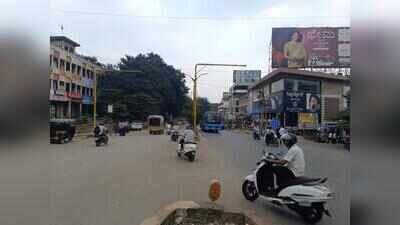
Hubballi: In a push to improve road safety and streamline traffic flow, the Hubballi-Dharwad Police Commissionerate, in collaboration with Hubballi-Dharwad Municipal Corporation (HDMC), plans to implement an AI-based Integrated Traffic Management System (ITMS) at 14 major signal junctions at an estimated cost of Rs 5 crore.Each junction will be equipped with eight high-resolution cameras capable of capturing clear images round the clock. Monitoring will be centralised through an ITMS command unit at the police commissioner’s office in Navanagar, reducing the burden of manual traffic enforcement.Officials said the technology is aimed at improving traffic management, monitoring vehicle movement and detecting traffic violations. Excluding junctions along the BRTS corridor, Hubballi-Dharwad currently has 21 signal junctions.Police commissioner Bhushan Borase told TOI that the system will initially be introduced at 14 important junctions. Eight state-of-the-art cameras will be installed at each location, with the entire network monitored through ITMS.Borase said the model draws from traffic management initiatives implemented in Belagavi, which, according to him, helped reduce accidents and traffic violations. The proposed system will use real-time AI feeds for automated detection of violations, continuous surveillance and optimisation of signal timings to facilitate smoother traffic movement in high-density areas.HDMC commissioner Rudresh Ghali said the civic body has prepared a Rs 5-crore plan to establish the AI-based ITMS at 14 junctions. Tenders for the project will be invited after the election model code of conduct ends.AI eyes on traffic violationsITMS is an AI-enabled monitoring network that interconnects traffic signals and continuously analyses traffic conditions at major junctions, roundabouts and roads. It can automatically detect traffic violations even in the absence of police personnel and generate e-challans that are sent to the registered mobile numbers of vehicle owners.The system can detect vehicles exceeding speed limits or jumping red lights and automatically scan and record their registration plates.Its cameras can also identify two-wheeler riders without helmets, triple riding and car occupants not wearing seat belts. Computer vision technology will be used to detect motorists using mobile phones while driving.Besides automated enforcement, the system will allow police to continuously monitor traffic conditions and regulate signals, helping improve traffic flow while reducing dependence on personnel deployed at junctions.
About The Author