







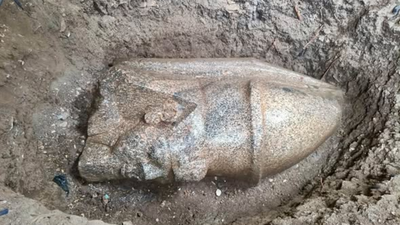
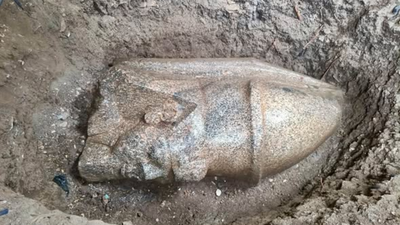
In Egypt’s Behbeit El Hagar, located in Gharbia province, a farmer truly dug deep. While tilling the land in front of his home, the man discovered a royal statue of Ramases II, the pharaoh who allegedly challenged Moses in the Bible. According to a report by the New York Post, the farmer flagged the local antiquities official, after which a team working for the Supreme Council of Antiquities launched an excavation, according to Heritage Daily.The treasure trove reportedly revealed an over 5-foot-tall head of Ramses II that’s depicted sporting the double crown of Upper and Lower Egypt. As per the size of the noggin, archaeologists projected that the entire statue measured over 27 feet tall, including the base. Researchers also recovered part of the statue’s back pillar, which bears an inscription containing one of the pharaoh’s royal names.Another, smaller royal statue that measured just under eight feet tall was also unearthed. Also uncovered was a 4-foot-high block of pink granite containing fragments of hieroglyphic inscriptions proclaiming the pharaoh “Nesu Beti”, meaning King of Upper and Lower Egypt and “Sa Ra,” meaning Son of Ra.While the figure’s legs and base were missing, its face was clearly visible and bordered by nemes, the striped royal headdress worn by ancient Egyptian pharaohs. These characteristics, along with the fact that the visage resembled the other statue, suggested that it was also a Ramses II facsimile.Ramses II, born in 1303 BC, is widely considered one of the most influential and powerful Egyptian kings of Egypt’s New Kingdom era (1570 to circa 1069 BC). The ruler is also popularly linked to the story of Moses in the biblical Book of Exodus, even though the holy text doesn’t mention him by name. In that account, the ruler enslaves the Israelites and defies Moses, incurring God’s wrath.Sherif Fathy, Egypt’s Minister of Tourism and Antiquities, said that the findings will hopefully contribute to a greater understanding of this region of the Nile Delta, which was a political, cultural and economic stronghold in ancient Egypt. The officials hope that further studies will help shed light on the statues and the architectural evolution of the repository during the epoch in question. Fathy also praised the homeowner for promptly reporting the stone rather than attempting to remove or keep it, highlighting the role ordinary citizens can play in protecting Egypt’s cultural heritage for future generations.Archaeologists are continuing to excavate the site and examine the relationship between the two statues, the inscribed granite block and their surroundings.
About The Author